Ad

space-iconSpace and Physicsspace-iconAstronomy
clock-iconPUBLISHEDAugust 31, 2023
share1.3k

India's Moon Rover Snaps Picture Of Lander At The Lunar South Pole

The mission has already hit the jackpot of discoveries.

James Felton headshot

James Felton

James Felton headshot

James Felton

Senior Staff Writer

James is a published author with multiple pop-history and science books to his name. He specializes in history, space, strange science, and anything out of the ordinary.

Senior Staff Writer

James is a published author with multiple pop-history and science books to his name. He specializes in history, space, strange science, and anything out of the ordinary.View full profile

James is a published author with multiple pop-history and science books to his name. He specializes in history, space, strange science, and anything out of the ordinary.

View full profile
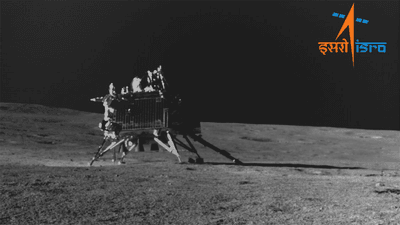
The Vikram lander at the lunar south pole.

The Vikram lander in all its glory.

Image credit: ISRO.


Last week, the Chandrayaan-3 lander and rover successfully touched down on the lunar surface, making India the fourth nation on Earth to land successfully on the Moon, and the first to land near the south pole. 

The rest of this article is behind a paywall. Please sign in or subscribe to access the full content.

The mission, aimed at examining the composition of the lunar soil, has already achieved another first; measuring the temperature at this previously unexplored region. Since then, it has hit the jackpot in its scientific activities, analyzing the composition of the surface of the Moon. 

During this busy time, the rover still managed to capture a photo of the Vikram Lander that brought it to the Moon.

The rover has so far detected sulfur, aluminum, calcium, iron, chromium, titanium, manganese, silicon, and oxygen. Sulfur is of particular interest to space-going nations, as it could potentially be used to make concrete.

The rover will continue its work to confirm these results. It has a planned working life of 14 days, though the Indian Space Research Organisation (ISRO) hopes that it will continue to work beyond this. 


Written by 

Add us as a Google preferred source to see more of our
trusted coverage in Search