


 Technology
 PUBLISHED



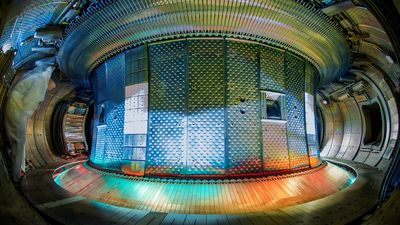


Nuclear fusion has the potential to deliver an enormous amount of energy. Many challenges in creating a stable fusion reaction are being overcome, but there are other technical issues that require solutions. One of them is about shielding the reactor from the fusing plasma. A new record has now been set for a tungsten-clad tokamak.
Since we can't create a star in the lab, we have to get creative. In tokamaks, donut-shaped fusion reactors, plasma is heated to millions of degrees. The plasma needs to be much hotter than the center of the Sun because the pressure in our reactors is so much lower. But you need to keep the plasma contained, and that's where the shielding comes in – and why this record is important.
The device in question is the Tungsten Environment in Steady-state Tokamak. Its acronym is WEST because W is the chemical symbol for Tungsten (TEST would work as well as the name of an experimental reactor). WEST reached 50 million °C (90 million °F) for a record six minutes. An incredible 1.15 gigajoules of energy was injected into the reactors (about the energy of a strong lightning bolt). That was 15 percent more energy and twice the density than previous tests.
“We need to deliver a new source of energy, and the source should be continuous and permanent,” Xavier Litaudon, CEA scientist and CICLOP chair, said in a statement. The CEA is the French Alternative Energies and Atomic Energy Commission, and together with the Princeton Plasma Physics Laboratory works on the fusion program CICLOP - Coordination on International Challenges on Long duration Operation. Scientists do love acronyms.
A paper with the results is coming in the coming weeks, but the announced data is exciting as it shows that a possible way forward for fusion shows the expected promise. “These are beautiful results. We have reached a stationary regime despite being in a challenging environment due to this tungsten wall,” added Litaudon.
Previous designs used graphite tiles that allowed for stable longer reactions. Graphite is just layers of carbon. It is easier to manipulate and integrate with the system, but might not be suitable for large reactors cause they trap fuel, a likely deal-breaker.
Tungsten, on the other hand, retains less fuel as well as possessing other important properties that make it a sensible choice. But if even a little bit of tungsten gets into the plasma it could cool down the reaction to the point there is no more fusion. So the environment needs to be well understood.
“The tungsten-wall environment is far more challenging than using carbon,” explained Luis Delgado-Aparicio, PPPL’s head of advanced projects. “This is, simply, the difference between trying to grab your kitten at home versus trying to pet the wildest lion.”
Innovative diagnostics were used to measure the plasma throughout the test, in ways that had not been done before. Showcasing not just the excellent results from the tungsten-clad tokamak but also the observation tools that can now be applied to other experimental reactors around the world.


 1
1