Culture and Society
 PUBLISHED


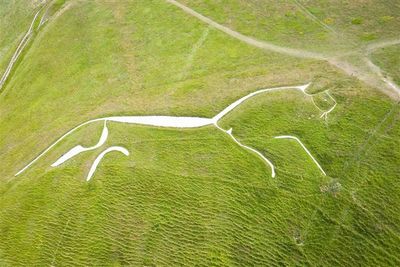


What may be Britain’s oldest giant chalk figure, the iconic Uffington White Horse, has been given some much-needed care after it had started to shrink and thin out. The restoration work has spruced up the ancient horse, allowing it to put on weight again and return to its former glory.
Last year, archaeologists with the National Trust realized that the chalk figure – located in Oxfordshire, England – was showing signs of decline. In particular, the neck and head of the 3,000-year-old horse figure were narrowing. As such, it was in need of some vital care.
As such, a team of archaeologists from the National Trust and Oxford Archaeology have now restored the loss by cutting away the turf that has been slowly nibbling away at its shape over the years. The team has also redistributed some of the chalk that was on the top layer of the figure.

The Uffington White Horse is just one part of a wider complex of ancient remains in and around what is called White Horse Hill. The figure itself was originally made from deep trenches that were dug into the hill and filled with chalk. It was created at some point in the Late Bronze Age or early Iron Age, sometime between 1740 and 210 BCE.
There are some who believe the figure may not be a horse at all, but rather a dragon-like creature, which may link it to the nearby Dragon Hill. This whole site is steeped in legend, apparently being the place where St George killed the dragon (despite the fact that the historical figure behind the legend was likely Turkish and had nothing to do with England).
While historians and archaeologists have a good idea of when it was created, they are less clear on why it was made.
“It is also an intriguing figure as we don’t know for certain its original purpose. It could have been a way of marking territory or as a tribal symbol. What we do know is that through the efforts of generations of local people, the horse has been cared for, allowing it to survive for thousands of years to become an iconic feature of this landscape," National Trust archaeologist Adrian Cox explained in a statement.
During the restoration work, soil samples from the horse’s lowest layers were taken in the hope that they may provide an accurate date for its creation. Similar samples were taken in the 1990s, which showed that it is Britain’s oldest chalk figure, but dating techniques have improved since then.
The hope is that the use of Optically Stimulated Luminescence (OSL) dating, which analyses crystalline materials such as quartz, will provide new insights. The results are due later this year.
For centuries, the horse’s shape has been maintained in so-called “scouring” festivals, whereby communities of people who clear away turf and weeds while also re-chalking it. The first known festival occurred in 1755 and was revived by the National Trust in 2009. The Trust now holds specific events for the public who are encouraged to help restore and maintain this enigmatic chalk figure.