Space and Physics
 PUBLISHED

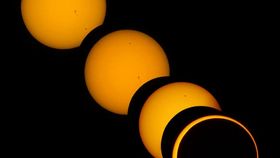


Early risers in much of eastern North America this Sunday 3 November will be able to witness the Sun rising while in partial eclipse. There will be a total eclipse along a narrow path over the Atlantic Ocean and equatorial Africa. The partial phase of the eclipse will be visible to many more people, including those in most of Africa, the Middle East, southernmost Europe, northern South America, and the Caribbean.
This eclipse is a rare hybrid eclipse, where some sections of the path are annular while other parts are total. This dual nature is created when the intersection of the Moon's umbral shadow pierces Earth's surface at some locations, but falls short of the planet along other sections of the path. The umbra, penumbra and antumbra are three parts of a shadow that are created by any light source after encountering an opaque object. The curvature of the Earth’s surface brings some geographic locations into the umbra while others are more distant and therefore enter the antumbral shadow, where an observer would see an annular eclipse.
For those in eastern U.S. and Canada, an open view of the eastern horizon will be needed in order to view the partial eclipse; the farther east you are the better. If watching from near the East Coast, the Sun will rise and appear to have a big bite out of its lower portion. This bite will diminish and then finally disappear, most likely within 45 minutes in most places, as the Moon continues its orbit and the Sun climbs higher in the sky.
Farther inland, the Sun will nice with the appearance of just a small notch cut out of it; this will last for a short time. The western limit of visibility for the partial eclipse runs through southern Ontario, Ohio, Kentucky, Tennessee, Alabama, and the Florida Panhandle. It should be noted this visibility is dependent on having a completely flat eastern horizon.
Sometimes the rising or setting Sun is reddened and dimmed enough for viewers to look at it directly however this is usually not the case. Looking at the Sun directly in its full blaze, even during an eclipse, may permanently damage your retina, leading to loss of vision or blindness. Safely observing the Sun requires a proper solar filter to remove more than 99% of the Sun’s light before it reaches your eyes. Such filters are required whenever viewing the Sun, whether during a partial eclipse or not. Sky & Telescope has some tips for observing the Sun safely.
The path of the eclipse is 47 kilometres (29 miles) wide when it makes landfall, in Gabon around 1350 GMT. Totality will last 68 seconds, before the Moon's shadow will continue east-northeastward across the Congo (up to 53 seconds), Democratic Republic of the Congo (44 seconds), Uganda (19 seconds), and northern Kenya (13 seconds), before ending in southern Ethiopia and westernmost Somalia (1 second, at sunset). Over the course of 3.3 hours, the Moon's umbra will travel along a path about 13,600 kilometres long, covering 0.09% of Earth's surface area.
Some partial eclipse times for North, Central and
An eclipse calculator for many locations is available here.
To take good pictures of the partial eclipse, photographers advise using a telephoto lens (100- to 500-mm focal length) to enlarge the Sun to a reasonable size while including some nice foreground.
Slooh will be covering the hybrid eclipse live from Kenya.