Culture and Society
 PUBLISHED
 8
8


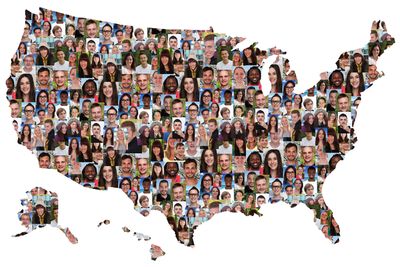


Anyone using social media at the moment will likely be aware of the increasingly heated debates surrounding migration, identity, and national cohesion. It feels like everywhere you look, people are getting more divided over the question of how white and Christian America should be. But what if this division is really just an illusion? According to a new study, the majority of Americans actually want a more ethnically and religiously diverse society than they currently have. It is only a very loud minority who think otherwise.
To be sure, this a question that is not peculiar to the US. Across Europe, debates are bubbling up over issues related to ethnicity, racial identity, and religious diversity. But the question appears to be particularly incendiary in America due to recent political events and a decade of increased media attention on right-wing patriotic groups who want an ethnonational state.
At the heart of many of these groups is the fear of the "great replacement", an ethnonationalist worldview and ideology that believes white Christians of European origin are being replaced by non-white, non-Christian immigrants. As with the wider social anxiety surrounding multiculturalism, fear of the great replacement is not just an American thing, but it has gained significant traction in the country in recent years. For proponents of this myth, there is a belief that lower birthrates among white Christians have allowed non-white non-Christians to become the majority, leading to the degradation of “traditional” American values, beliefs, and practices. In some extreme cases, believers think this replacement is all part of some wider sinister conspiracy to cause demographic change.
But while anxiety over this perceived phenomenon appears to be high at the moment, is it representative of how Americans really feel about multiculturalism? Not according to a new study conducted by researchers at the University of Copenhagen, Yale University, and the University of Chicago. The researchers surveyed a representative sample of 986 American citizens and found some surprising results concerning views of multiculturalism.
"We wanted to investigate whether the idea of a multicultural United States still has popular support – and it does, to a large extent," Séamus Power, associate professor at the Department of Psychology at the University of Copenhagen, explained in a statement.
"Two-thirds of participants wanted a more ethnically diverse United States than the current one, and more than half wanted greater religious diversity," he added.
Interestingly, Power and colleagues discovered that even among white Christian Americans, the group most often associated with "great replacement" fears, the majority were in favor of greater diversity.
"It is important to understand that the idea of a great replacement does not reflect the majority view. Our data shows that only 1.1% want an ethnically homogeneous United States, and only 3.2% want a religiously homogeneous society," Power explained. "Although we should not underestimate the significance of these extreme views when they are scaled up to the entire population of the United States."
The research also indicated that, in general, Americans overestimate the proportion of minority groups in the country, while underestimating the scale of white and Protestant populations.
"While it is not hard to imagine how some White people in the United States might feel threatened by this pattern, especially when the pattern is represented as negative and threatening by mainstream media," Power and colleagues write in their paper, "one of our main findings is that most Americans, including White Christians, have a multicultural conception of what ‘America’ means."
The team believes these results can contribute to the often polarized debates on identity and belonging in the United States.
"It is crucial to the debate to know that it is not the desire for uniformity, but the acceptance of diversity that characterises Americans' ideal image of their nation. Multiculturalism is perhaps more American than apple pie," Power concluded.
The study is published in Ethos.