Culture and Society
 PUBLISHED
 6
6



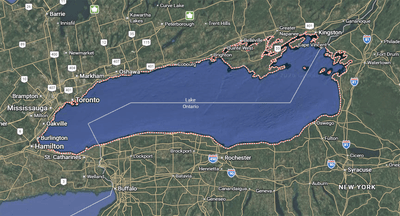


Following an executive order from US President Donald Trump, Google has made a controversial update to its Maps product, leaving Canada as the only place in the world where Lake Ontario is still labeled as "Lake Ontario."
Although keeping track of the president's relentless spats is something of a full-time job, you may be aware that his most recent frustrations ended up being taken out on a lake, resulting in Lake Ontario being officially renamed "Lake America" after a breakdown in trade talks with Canada.
The change, while unlikely to affect anyone other than US government website maintainers (and perhaps some unfortunate soul who will have to make a very big sign), has clearly elicited the desired response from north of the US-Canada border, which splits the lake down the middle.
"The name Lake Ontario comes from the Wendat word Ontari’io, which, appropriately, means 'the lake is beautiful, the lake is big,'" Canadian Prime Minister Mark Carney said on X, reacting to the change.
"The name is more than 400 years old, predating both the Confederation of Canada and the Declaration of Independence of the United States of America. We know that America is changing. Their trading relationships, their foreign policies, their national monuments, their hydronyms. Canadians also know that naming reality means calling it Lake Ontario – then, now and always."
Ontario Premier Doug Ford, meanwhile, simply erected a giant sign reading "Lake Ontario: now and always" on the lake's shoreline.
It's all pretty stupid, and not in a particularly new way, either, with a similarly ridiculous dispute happening over the Gulf of Mexico in 2025. It isn't clear what effect that had on anything, with the world's media largely ignoring the rebrand and continuing to use "Gulf of Mexico," the name the body of water has had since the 16th century.
That said, US-based mapmakers have been split on how to respond to the situation. While the executive order, entitled "Honoring the American History of the Great Lakes and Renaming Lake Ontario as Lake America," has officially changed the name of the lake, this strictly only applies to federal government sources.
US online map service MapQuest posted on X that it would not be changing the name of the lake, and it also provided a link to a site where people can produce images of the lake with whatever name they want. As of August 31, Apple Maps has also opted to keep Lake Ontario.
Google, on the other hand, has taken a different approach. Rather than react to changes individually (who knows what will be renamed "America" next), the company announced last time around that it has a policy to follow whenever names are changed by government sources.
Though (perhaps) the most consistent option with respect to the tech giant's past decisions, the result is pretty silly.
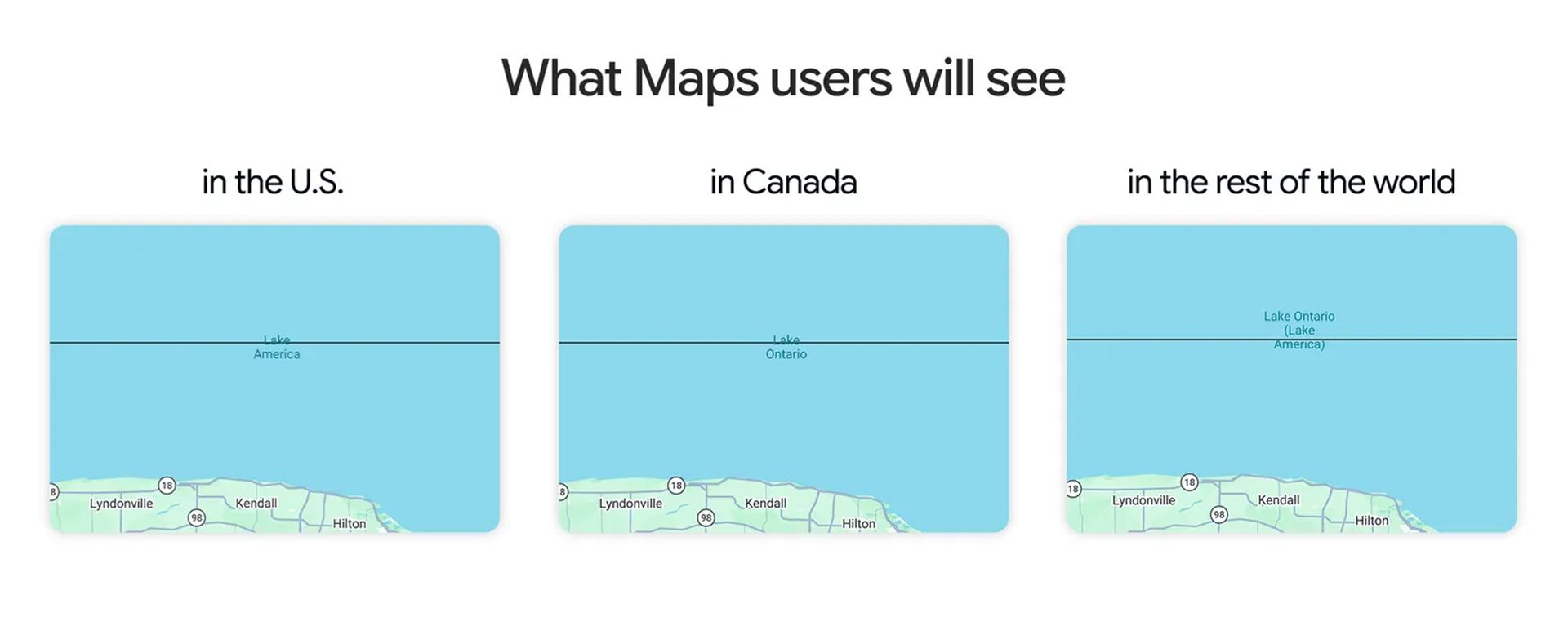
"The U.S. Geographic Names Information System (GNIS) has formally changed the name for 'Lake Ontario' to 'Lake America' in the United States," Google posted in an update.
"Since we update Google Maps to reflect name changes in official government sources, which is GNIS for the U.S., people using Maps in the U.S. will see 'Lake America,' those in Canada will continue to see 'Lake Ontario,' and those outside of the U.S. and Canada will see both names. These updates follow our long-standing policy for bodies of water with names that vary from country to country, and are starting to roll out now."
That rollout seems not yet to be entirely complete. With admittedly a very small sample size, as of August 31, IFLScience team members based neither in Canada nor the US have seen all three combinations of name schemes, only adding to the confusion
The search giant labels other disputed names in the same fashion, with the Persian Gulf, known as the Arabian Gulf in some nations in the region, labeled as "Persian Gulf (Arabian Gulf)." The Sea of Japan, known as the East Sea to North and South Koreans, is similarly labeled as Sea of Japan (East Sea) for users worldwide. Although we should note that these are historic disputes that have gone on for many years, rather than slapping the name "America" on something when trade talks aren't going too well.