Humans
 PUBLISHED


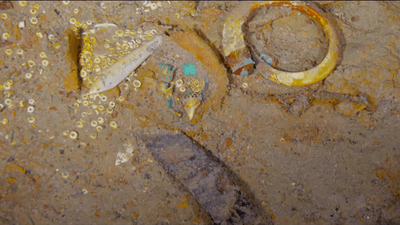


A team has discovered a gold necklace that’s not been seen since the sinking of the Titanic in 1912. Recently found among the ship’s wreck off the coast of North America, they are even hoping to find the family of the jewelry's owner by using artificial intelligence (AI).
The insight comes from Magellan, a UK-based deep-sea mapping company, who recently released a selection of digital scans showing the shipwreck of RMS Titanic in never-before-seen detail.
In a follow-up to this news, the company has explained how their stunningly high-quality images show a gold necklace made from the tooth of a Megalodon, a colossal extinct species of shark.
Fans of the 1997 movie Titanic will be aware that the fictionalized story involves a beautiful necklace known as the Heart of the Ocean. Who knows, perhaps this recent find was a gift between two ill-fated lovers.
Richard Parkinson, CEO of Magellan, described the discovery as “astonishing, beautiful and breathtaking.”
"What is not widely understood is that the Titanic is in two parts and there's a 3-square-mile [8-square-kilometer] debris field between the bow and the stern,” Parkinson told ITV News.
"The team mapped the field in such detail that we could pick out those details," he added.
The project gathered a massive 16 terabytes of data detailing the wreck site, including over 715,000 images and full 4k video footage.
They achieved this by sailing out to the wreck, some 700 kilometers (435 miles) off the east coast of Canada, then using remotely-operated submersibles to image the seabed at a depth of around 3,800 meters (12,500 feet) below the water's surface.
RMS Titanic was an ocean liner that famously sank in the North Atlantic Ocean on April 15, 1912, after striking an iceberg during her maiden voyage from Southampton in England to New York City.
At least 1,500 passengers died and the wreck sunk to the seabed, some 4,000 meters (13,123 feet) below sea level around 740 kilometers (400 nautical miles) from Newfoundland in Canada. The final resting place of the Titanic wasn’t discovered until September 1985, 73 years after it met its icy fate.
Due to current agreements that protect the site, the public is not allowed to remove any artifacts from the wreck and surrounding bed.
However, the team at Magellan hopes they will be able to reunite this piece of jewelry with the family of its owner. They’re using AI to find and contact the family members of the 2,200 passengers onboard when the ship sank with the aim of identifying the person who once wore the necklace.
They’ll also study footage of passengers boarding the ship to see whether they can spot the jewelry and identify the owner using facial recognition technology.