Nature
 PUBLISHED


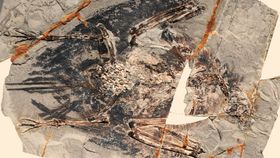


For the very first time, researchers have come across the fossilized remains of an ancient set of proto-bird lungs. Not only is this unbelievably rare 120 million-year-old artifact a gorgeous sight to behold, it’s now also helping palaeontologists piece together how modern birds evolved the gift of flight.
A new study, published in the journal Proceedings of the National Academy of Science, has detailed the discovery of the first known fossilized lungs belonging to an early bird ancestor, Archaeorhynchus spathula, a pigeon-sized beast from the early Cretaceous period. Much to their surprise, the lungs share many of the key features of the hyper-efficient respiratory system found in modern birds, something that’s never been found before in early bird and dinosaur lineages.
Fossilized organs are a gold mine for palaeontologists, however, as you can imagine, they are also incredibly rare. This beautifully preserved individual met its fate some 120 million years ago, alongside dinosaurs during the Early Cretaceous period, after an unfortunate run-in with a volcano in what is now modern-day China.
Fortunately for us, a freak set of circumstances allowed some of its lung tissue to become fossilized. No one can be certain how, but University of South Florida palaeontologist Ryan Carney, a feathered dinosaur expert, told National Geographic it could have been caused by the poor proto-bird inhaling a gust of volcanic ash.
Researchers were originally attracted to the fossil by its carbonized feathers. However, the use of scanning electron microscopy picked up on a strange speckly white material in the chest not previously seen in any other fossil. A deeper analysis suggested that this was perhaps lung tissue – and very interesting lung tissue indeed.
Since beating your wings for flight requires a hell of a lot of oxygen, modern birds have developed lung structures that allow for extremely efficient respiration thanks to unidirectional airflow in the lungs, supplementary air sacs, and divided lung tissue with an enormous surface area to diffuse oxygen across. The lungs of A. spathula appeared to show signs of this specialization, namely an extremely subdivided lung structure that helps to dramatically up the surface area.
Despite these adaptations, it is fairly unlikely that Archaeopteryx was capable of sustained powered flight, although it might have been able to manage a short flutter. Nevertheless, the researchers argue that this early hint of lung adaptation perhaps gave rise to the fundamental features of birds that allowed the modern bird to develop sustained fight and helped their ancestors make it out alive from the age of the dinosaurs.