Space and Physics
 PUBLISHED
 1
1



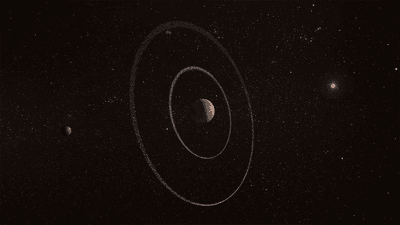


Rings around worlds used to be a straightforward concept: If you have material in orbit within a certain distance, you get a ring. If it’s further out, the material coalesces into a moon in a matter of decades. In February, astronomers announced that the dwarf planet Quaoar has a ring where it shouldn’t be possible to have one. Now, new research suggests there is also a second one, and this defies our understanding of ring formation as well.
In every other body in the solar system, rings are found within the Roche limit, a distance that depends on the density of the world and the density of the material around it. Rings have always been within that value, whether we consider the majestic rings of Saturn or the small double rings of asteroid Chariklo. But Quaoar has decided to be special.
The dwarf planet is about 555 kilometers (345 miles) in radius and is roughly 43 times as far from the Sun as Earth. Quaoar is orbited by a small moon, called Weywot, of about 160 kilometers (100 miles) in diameter. Weiwot orbits at about 14,500 kilometers (9,000 miles), or about 24 radii of Quaoar. The first ring is located at 7.5 radii or 4,050 kilometers (2,500 miles).
The second ring is located at 2,500 kilometers (1,550 miles), also well beyond the classical Roche limit for Quaoar, which is 1,780 kilometers (about 1,100 miles). This world alone is challenging the classical notion of where and how dense rings can survive. Clearly, the Roche limit is not a limit at all when it comes to Quaoar.
So how is Quaoar pulling off this apparently physics-defying trick? Researchers believe that the key might be orbital resonance.
If two moons are in resonance, their orbital period (the time it takes them to go around their planet) would be an integer multiple. For example, one moon takes three days and the other one six, so they are in a 1:2 resonance.
The first ring is within two possible resonances: one to do with Weywot (6:1) and one with Quaoar’s spin-orbit resonance (1:3). The second ring is also near a spin-orbit resonance (5:7). To determine whether this is indeed the case will require more work and more observations.
This new discovery was possible thanks to the stellar occultation of August 9, 2022. This provided nine effective occultation chords obtained in Hawaii, Mexico, and the continental United States that allowed astronomers to refine the size of Quaoar as well as expand our understanding of the ring.
The research is accepted in the journal Astronomy & Astrophysics.