Space and Physics
 PUBLISHED


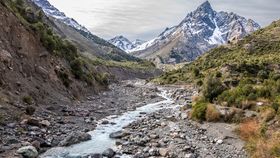


The great mountain ranges are formed when one tectonic plate is pushed under another, lifting the top plate up. Once the process stops, mountains are worn down by weathering and erosion. Geologists are locked in debate as to whether erosion, particularly from glaciers, determines the mountains' heights while the forces below continue, but new evidence suggests rain, wind, and ice are largely irrelevant.
The amount of weathering a mountain range experiences depends on the climate and therefore location. In tropical regions, mountains can become very high before they form glaciers, whose movements will erode them. Closer to the poles, the snowline is much lower. According to one theory, this means that high latitudes can never support high altitudes.
Dr Armin Dielforder of the GFZ German Research Center for Geoscience has presented evidence for an alternative view. Dieldforder estimated the forces within the Earth that raise ranges in the first place. He argues the forces raising ranges at plate boundaries are proportional to the frictional energy between the plates. This, in turn, can be estimated by measuring heat flow produced by this friction as well as factoring in the dip angle of the point of collision and the density of the wedge of mantle material supporting the upper plate.
The matches between the measurable heat and the upward forces Dielforder is trying to estimate may not be perfect; at minimum, different rock types represent a complicating factor. Nevertheless, Dielforder considers heat flow a good proxy for the crustal forces that make mountains.

Rather than looking at the highest peaks, Dielforder considered the average height of each range, smoothing out the mountains and valleys. When Dielforder graphed 10 mountain ranges' (including three sections of the Andes) average altitudes against their estimated crustal forces, the correlation is impressive, suggesting these forces, rather than climatic conditions, control their height.
Presenting the results in Nature, Dielforder and co-authors argue that although erosion undoubtedly wears away at mountains, its effects are balanced by forces from below. In an accompanying News and Views piece, Kelin Wang of the Pacific Geoscience Center draws an analogy with icebergs. If material is removed from the top, the natural buoyancy of the ice will cause it to rise out of the water, almost counteracting the effect.
However, Wang expresses skepticism about Dielforder's conclusions, noting most of the sample is made up of ranges of modest height. If the effects of glacial weathering only really kick in at great heights or very high altitudes, Dielforder's work will be relevant for low-rise ranges, but not for the highest peaks. Moreover, Dielforder assumes the horizontal and compressions beneath mountain ranges are the same, where other geologists expect horizontal stresses to be greater, which would undermine the conclusions.



 3
3