Space and Physics
 PUBLISHED
 1
1



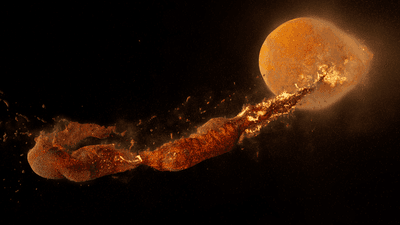


You would think that making our Moon would take a long time, longer, for example, than the time it takes me to reply to an email I've been avoiding. Instead, new research finds that, under hot enough conditions, our wonderful Moon might have come to be in a matter of hours.
The Moon is believed to have formed when a hypothetical object called Theia slammed into the primordial Earth. Theia is thought to have been a Mars-sized protoplanet whose remains were incorporated into the Moon and also buried deep inside our Earth.
For a long time, researchers believed the energy of this impact was so high that the specific properties of Theia wouldn't have mattered to the Moon's formation. New simulations challenge that notion.
If Theia was a hot but solid body, just like Earth, the impact would have been significantly different than in the case of a colder Theia. Hotter bodies are weaker than colder ones, and these simulations suggest that moon formation scenarios are very sensitive to temperature as a result.
"We discovered that the preexisting geology of the Mars-sized proto-moon matters," Dr. Adeene Denton at the Southwest Research Institute in Texas said in a statement. "When you simulate the Earth and the moon as colliding bodies with geologic properties, it changes how the moon forms out of that impact—that's something we considered unnecessary before."
So the Moon might have taken a long time to form, eventually coalescing from a protolunar disk surrounding Earth. This had been the main view. However, some simulations that take the properties of Theia into account now show a speed-run version of that formation, in which the Moon emerges out of the collision in a matter of hours.
This isn't the first time such a speedy formation has been proposed, as another prominent simulation study from 2022 showed formation on a similar timeframe. It is the first, however, to show that the material strength and temperature of the colliding object have a massive bearing on what kind of scenarios could play out.
"Depending on how hot the Earth and Theia are prior to the collision, the impact can destroy Theia and produce this massive disk of debris that eventually forms the moon," Denton said. "But when I used the same parameters as original impact modeling—down to the equal temperature structures inside both bodies—within about five hours, an intact moon emerged."
There are properties of the Moon today that don't seem to match the classic impact formation view. A more flexible formation scenario, as suggested by this work, could help solve those problems. In other words, these new, more sophisticated models might be onto something.
"Models have evolved to include material strength, something that's really important when you're studying collisions between smaller bodies like asteroids or for my previous paper about the formation of the Pluto-Charon system," Denton said. "We weren't sure if it would matter for the moon or not. When we did the simulations, we found it actually matters quite a bit."
A paper discussing this work was published in The Astrophysical Journal Letters.