Ad

space-iconSpace and Physicsspace-iconAstronomy
clock-iconPUBLISHEDAugust 16, 2022
comments icon1
share280

Check The Full Hubble Wispy View From Inside The Orion Nebula

The veteran space telescope spotted the effect of a newborn star on the nebula’s gas.

Dr. Alfredo Carpineti headshot

Dr. Alfredo Carpineti

Alfredo has a PhD in Astrophysics and a Master's in Quantum Fields and Fundamental Forces from Imperial College London.

Space & Physics Editor

Alfredo has a PhD in Astrophysics and a Master's in Quantum Fields and Fundamental Forces from Imperial College London.View full profile

Alfredo has a PhD in Astrophysics and a Master's in Quantum Fields and Fundamental Forces from Imperial College London.

View full profile
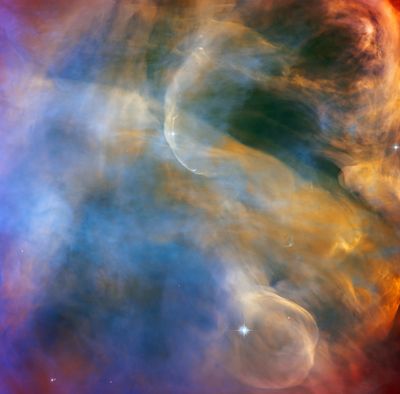
HH 505 in the Orion Nebula Seen by Hubble. Image Credit: ESA/Hubble & NASA, J. Bally Acknowledgement: M. H. Özsaraç

The Orion Nebula is one of the best-known stellar nurseries. In the vast expanse of interstellar gas, new stars are being born. The Hubble Space Telescope has observed it many times, and the latest image comes from a little area on its outskirts that focuses around the star IX Ori and the effect that has on the surrounding gas.

The rest of this article is behind a paywall. Please sign in or subscribe to access the full content.

What we are seeing is a Herbig-Haro object called HH 505. Outflows, such as jets, from stars and protostars form when they collide with gas clouds. They are not particularly big in mass, between one to 20 times the mass of Earth (a tiny fraction of the stellar mass), but they can be very bright and hot, reaching temperatures between 8,000 and 12,000 Kelvins. They carve wonderful shockwaves in a stellar nursery nebula.

HH 505 in the Orion Nebula Seen by Hubble. Image Credit: ESA/Hubble & NASA, J. Bally Acknowledgement: M. H. Özsaraç

The Orion Nebula has thousands of newly born stars, and at roughly 1,000 light-years away it is the closest region of massive star formation to the Solar System.


Add us as a Google preferred source to see more of our
trusted coverage in Search