Technology
 PUBLISHED
 7
7


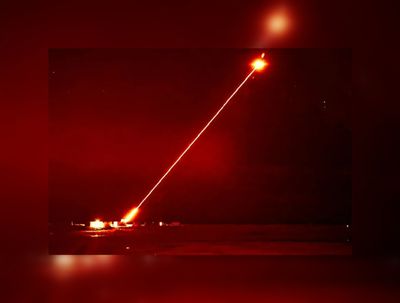


The UK Ministry of Defence (MOD) has recently been showing off its latest laser directed energy weapon (LDEW) known as DragonFire.
At the MOD's missile range in the Hebrides, a picturesque archipelago off the west coast of the Scottish mainland, DragonFire was recently used on an airborne target. Precise details on the test were not revealed, but it did produce some impressive imagery of a red beam striking an object in the night sky.
The weapon is incredibly precise, capable of hitting a coin-sized target from 1 kilometer (0.62 miles) away. The MOD has remained hush on its potential range, stating that the information is classified, but they do claim “it is a line-of-sight weapon and can engage with any visible target.”
Although it does look like something straight out of Star Wars, laser weaponry has some real benefits over conventional ammunition beyond its aesthetic value. The MOD and private industry have invested £100 million into the DragonFire weapon system, but it could prove to be a money-saving investment in the long term.
That’s because missiles, bullets, and other flying packages of destruction can cost a lot of money.
To down a drone, the UK military will typically use missiles that cost £1 million ($1.28 million) a pop. However, DragonFire can achieve the same results at less than £10 ($12.8) per shot. Despite its intense energy, firing the weapon for 10 seconds costs about the same as blasting a household heater for an hour.
Collateral damage is also of little concern with lasers. A misfired missile can cause all kinds of unwanted damage, but a laser beam will just continue to travel until it is harmlessly absorbed and scattered by Earth’s atmosphere.
“This type of cutting-edge weaponry has the potential to revolutionise the battlespace by reducing the reliance on expensive ammunition, while also lowering the risk of collateral damage,” Grant Shapp, the UK Defence Secretary, said in a statement.

“The DragonFire trials at the Hebrides demonstrated that our world-leading technology can track and engage high-end effects at range. In a world of evolving threats we know that our focus must be on getting capability to the warfighter and we will look to accelerate this next phase of activity,” added Shimon Fhima, Director of Strategic Programmes for the MOD.
There are many challenges ahead before battlefields start looking like a deadly disco. As explained in the article for the Conversation with Gianluca Sarri, Professor at the School of Mathematics and Physics at Queen's University Belfast, laser weaponry currently needs to be focused on their target for some time and it can be difficult to keep the laser stable on a moving platform, such as a ship on rocky waves, or aimed at rapidly moving target.
Nevertheless, plenty of other militaries around the world are starting to explore this novel technology. In February 2022, for instance, the US Navy demonstrated a laser weapon that could disable or even destroy incoming subsonic missile targets whether they are in the air or on the sea.