Health and Medicine
 PUBLISHED


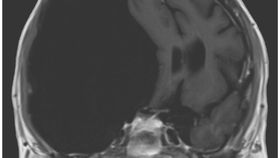


You see that massive black patch in this MRI scan? That’s a super-sized cyst lodged in between the brain and the skull.
The image was published online in the New England Journal of Medicine’s Image in Clinical Medicine this week.
This strange medical case recently came to light when a 27-year-old man was rushed to the emergency department at Metro Health Hospital in Wyoming after suffering from his first seizure. He told the doctors he had been suffering from frequent headaches and falls for over three years.
A prompt magnetic resonance imaging scan of his brain revealed the problem: a massive arachnoid cyst squishing the brain against the skull. The cyst is estimated to measure 12.3 by 16.5 by 7.9 centimeters (4.8 by 6.4 by 3.1 inches).
Arachnoid cysts are a thin sac filled with cerebrospinal fluid, a colorless fluid found in the brain and spinal cord. These specific cysts are found between the brain or spinal column and one of the membrane layers that surround the brain. The exact cause of them is unknown. Although, fear not, this is a particularly large one.
The doctors performed a craniotomy on the man. This is a procedure where a small portion of the skull is removed during surgery to allow them to drain the fluid and relieve the pressure. Follow-up imaging showed that this actually did not change the size of the cyst. The man still suffers from headaches every day and is fending off more seizures with anti-epileptic therapy.