Space and Physics
 PUBLISHED
 1
1





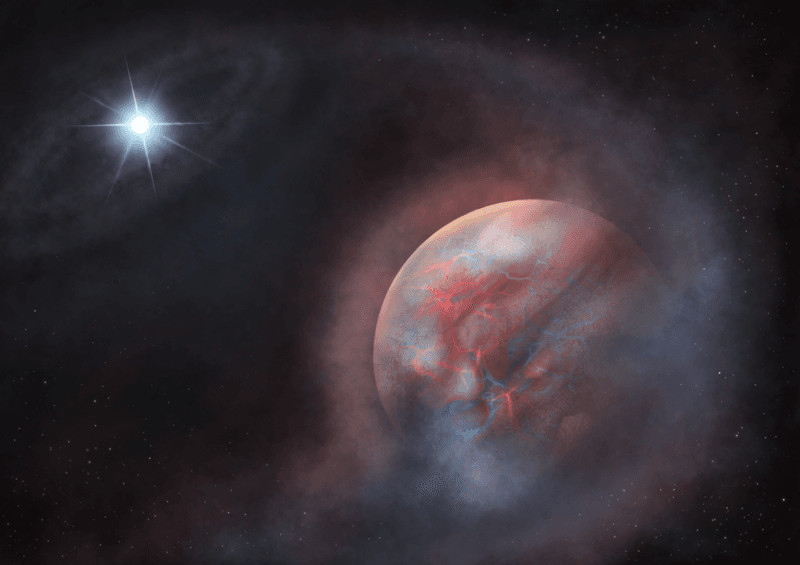
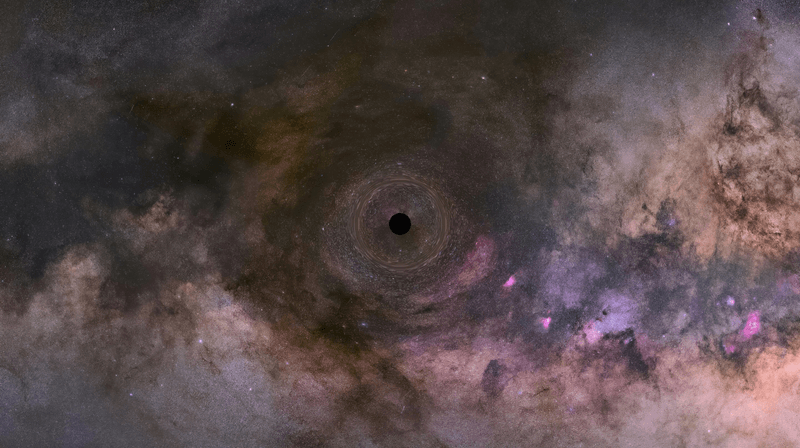
We all have those snacks we can’t resist. And it seems that two particular supermassive black holes are the same way. Repeated flares have been spotted coming from the centers of two galaxies, where their supermassive black holes reside. These sudden brightenings were a type of tidal disruption event (TDE). A star got too close to the black hole, was ripped apart, and the stellar material was heated as it spiraled toward the black hole.
Usually, these TDEs are a one-off transient event, because the star in question is completely ripped apart, but in the case of eRASSt J045650.3–203750 and AT2018fyk, which are located almost 900 million light-years and 1 billion light-years away, the two have not killed the stars just yet. As the object comes closer to the black holes, they take some of its material, causing a repeated TDE.
The first example was spotted by the X-ray telescope eROSITA and then followed up by the European Space Agency’s XMM-Newton. The star in question appears to get too close to the black hole every 233 days.
“The results from our first XMM-Newton observation were surprising. The black hole showed an unusually drastic dimming of X-ray light, compared to when it had been discovered two weeks previously by the eROSITA telescope. Follow-up observations with XMM-Newton and other instruments confirmed our speculations that this behaviour was being caused by a partial tidal disruption event,” one of the two teams’ leaders, Zhu Liu from the Max Planck Institute for Extraterrestrial Physics, said in a statement.
The second event, spotted by the All-Sky Automated Survey for Supernovae shone brightly for at least 500 days and then dimmed before shining back up 1,200 days after the original event. The behavior was not easily explained, but the team had different models to test the data against.
“At first, we were absolutely puzzled by what the rebrightening could mean. We had to go back to the drawing board to assess all the possible options to explain the observed behaviour. It was a very exciting moment when we realised that the model for a repeating tidal disruption event could reproduce the observed data,” explained the other team leader, Thomas Wevers, from the European Southern Observatory.
Usually, stars that get tidally disrupted are just passers-by that got unlucky enough to be too near. The new studies suggest that the stars had been pulled in a close orbit around the black hole. And the teams are planning to keep an eye on these two systems around the predicted return time. Hopefully, the stars are still there and were not completely devoured during the last passage.
The paper describing the work done by Liu’s team was published in Astronomy & Astrophysics. Wevers et al's paper has been accepted by The Astrophysical Journal Letters and is available on the ArXiv.