Technology
 PUBLISHED
 7
7


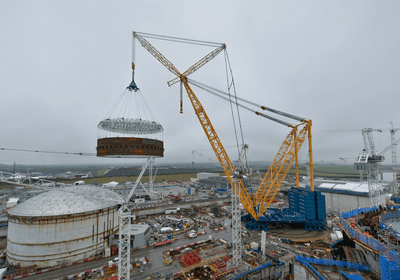


Meet SGC-250 – known as “Big Carl” to his friends – the biggest land-based crane in the world.
Fully upright, Big Carl can reach heights of up to 250 meters (820 feet), according to Sarens, the Belgian construction company that owns the crane. The heavy lifter is able to hoist up an impressive 5,000 tonnes with the help of 12 high-performance engines working in unison. For context, that weight is the equivalent of around 1,000 cars.
The crane can rotate 360 degrees with a radius of 100 meters (330 feet) thanks to several wheels that are attached to a set of tracks. Another set of wheels also allows Big Carl to have some limited movement around a construction site along the tracks, which is pretty remarkable for a beast this size.
You probably won’t see Big Carl on any old building site. The machinery is generally used to lift extremely heavy pre-assembled modules on specialized construction yards. For example, in 2022, it completed its first job of placing a 304-tonne steel liner ring, the last of three, onto a reactor at Hinkley Point C nuclear power station in the UK.

"This crane was inspired by the increasing trend towards modularisation and the move away from stick-built construction. Instead of putting a refinery together piece by piece, our clients now prefer to pre-assemble large portions, or modules, in a controlled environment and then transport and lift them into their final position," Carl Sarens, the company's director of technical solutions who the crane is named after, said in a statement.
“Because of their weight, these modules require higher lifting capacities. This trend, together with our in-house engineering expertise, led to the construction of this enormous crane,” he added.
Notice we said that the Big Carl is the world’s biggest land-based crane. That’s because there is, in fact, a larger crane that sits on top of a giant ship-like vessel. Sleipnir is a Dutch-owned semi-submersible vessel that’s equipped with two cranes, capable of lifting 10,000 metric tonnes each. Named after Odin’s eight-legged horse, the floating colossus is typically used for installing and decommissioning offshore energy projects, like oil rigs.
Who would win in a fight? It's hard to tell, but Sleipnir certainly has the weightlifting advantage.