Space and Physics
 PUBLISHED
 2
2


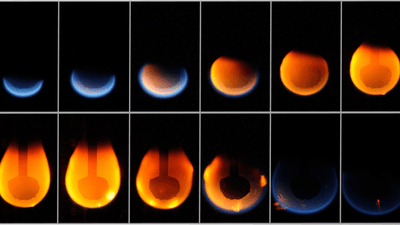


Astronauts aboard China's Tiangong space station have lit a candle inside it, to demonstrate how flames act in zero gravity.
Gui Haichao and Zhu Yangzhu lit the candle while live-streaming a lecture to viewers down below. On Earth, the hot gases from the flames rise while gravity pulls cooler and denser air downwards to the bottom of the flame. In the microgravity environment of a space station, this doesn't happen and the flame becomes spherical.
While cool in a demonstration, fires and space are not a great mix. There was a real fire on Mir back in 1997, which lasted several minutes and cut off access to one of the Soyuz escape vehicles docked to the space station. The crew managed to put out the fire, but the situation was pretty hairy for a time.
“The fire was so enormous and the smoke and vapour coming off this fire site was such that we couldn’t see at arm’s length," European Space Agency (ESA) astronaut Reinhold Ewald said of the incident, "and I could not at that time have imagined that we go on with the mission."
Another problem with flames on space stations is that the lack of gravity makes them more difficult to detect.
“As the gravity field is reduced on Mars (0.38 g) or on the Moon (0.16 g), buoyancy decreases and the typical time required to detect a fire with regular equipment is consequently greater,” Guillaume Legros of France’s Institut de Combustion, Aérothermique, Réactivité et Environnement told ESA.
“Worse still, in a spacecraft, there is no buoyant flow and the smoke will consequently follow the complex air motion imposed by the ventilation system, leading to a longer fire detection time by smoke detectors typically placed along the vent lines.”
If a fire breaks out, cosmonauts on the Russian section of the International Space Station (ISS) have water-based fire extinguishers, while the US section has a carbon dioxide extinguisher.
"Of course, we have to be careful when using the fire extinguisher to either secure ourselves against a wall or have a second astronaut stand behind us and hold us in place," ESA astronaut Matthias Maurer explained in a German Space Agency video. "The recoil from spraying one of the extinguishers can be quite strong and would send me flying backwards."