Humans
 PUBLISHED





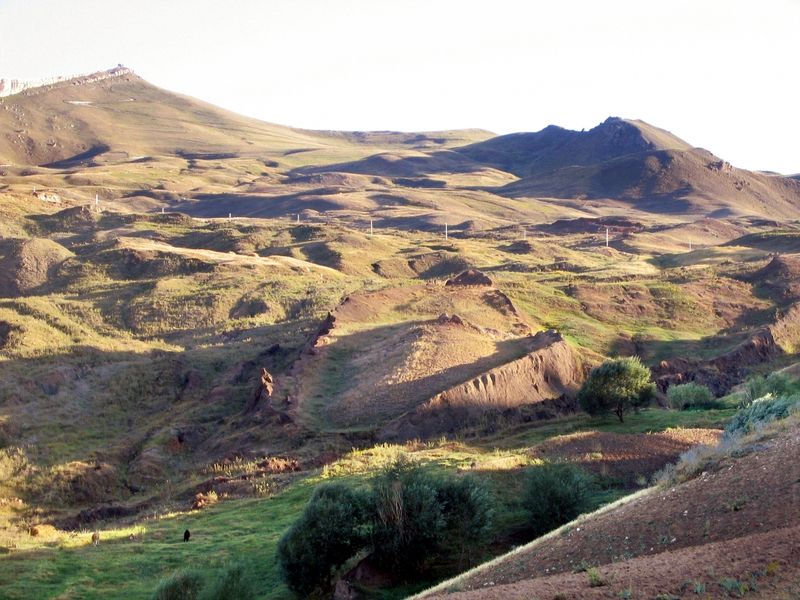
Diana Zardaryan couldn’t have known, back in 2008, when she walked in through the split in the towering cliffs that led to the Areni-1 cave in southeastern Armenia, that she was about to make history.
“I knew that organic artifacts are very rarely found during excavations,” she later told journalists covering her story. When she announced what she had found, “nobody believed me.”
But what had caused all this fuss? Something big was, you could say, afoot.
‘People, my dream has come true: I’ve found a shoe.’
The team had good reason to investigate Areni-1. “This cave is special in Armenia, in particular, because it's a crossroad between Africa, Asia, and Europe,” explained Ron Pinhasi, an archaeologist then at University College Cork and now at the University of Vienna, back in 2010.
“More than likely, in the period – the Chalcolithic period – it was already a major crossroad, a major station perhaps, a trading post, or perhaps a place of strategic importance in the routes between different civilizations.”
In fact, “all of Armenia is very rich in archaeology for any period,” he pointed out. “At the same time, Armenia is not really excavated as much as other regions. And therefore, there's a lot of unknown and mysterious elements to it.”
Indeed, Armenia is notorious for the headline-grabbing finds it has turned up: from badass female warriors to prehistoric dragon stones to an ancient winery that would put literally any other vintage on Earth to shame. But none of that is what Pinhasi and Zardaryan had stumbled upon – no: they had found a shoe.
“We were cleaning up the clay floor […] and all of sudden a large cluster of dry reeds came up,” recalled Zardaryan, who was just a 25-year-old postgraduate student at the time of the dig. “I asked laborers to go out so I could take a closer look at them.”
“As I removed more soil from the reeds, I got deeper and deeper into them and then exposed a very beautiful and special pit,” she said. “It was plastered with very high-quality yellow clay.”
At the bottom of this pit, she saw something strange: an upturned bowl, strewn with a pair of horns from a nanny goat and the spine of some kind of fish. Scrabbling in the dark, she carefully lifted the clay bowl – there was something underneath, but she couldn’t make out what it was.
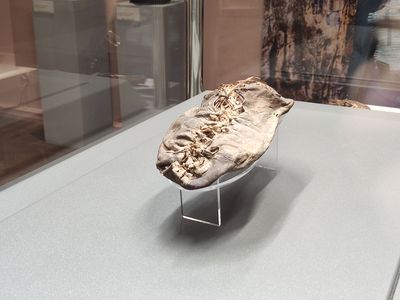
“I felt some organic stuff, which I at first thought was a cow ear,” she recalled. “I took it out and got absolutely transfixed. It was a shoe turned upside down.”
‘Even the shoelaces were preserved.’
At first, nobody knew what they had on their hands. “We thought initially that the shoe and other objects were about 600 to 700 years old,” Pinhasi said in 2010. “They were in such good condition.”
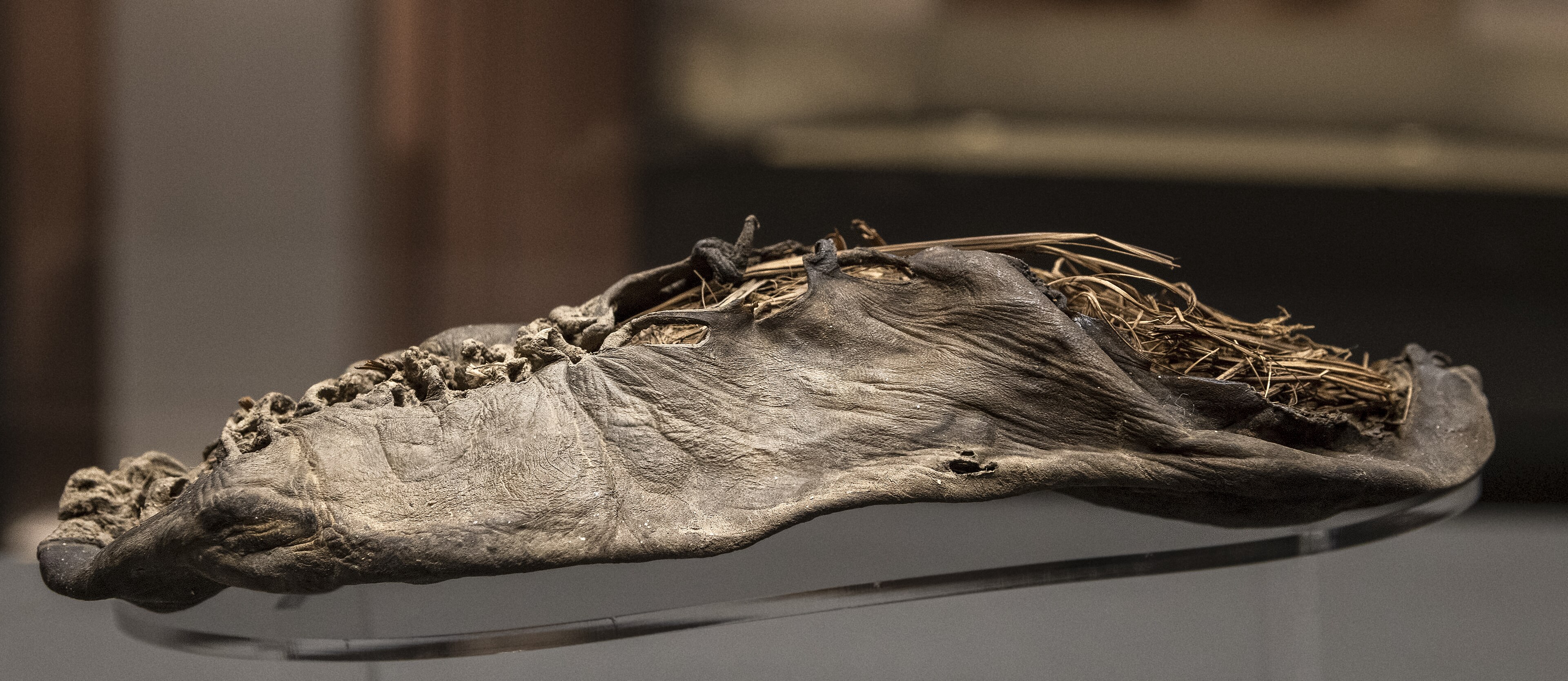
It was a right shoe, the investigators found; made from a single piece of cowhide – a technique today known as both “wholecut” and “really expensive” – with 19 sets of eyelets threaded through with a leather thong. It was, very recognizably, a shoe.
“This is a shoe in the modern sense, in that the same technology and manufacturing method utilized by the Areni-1 people prevailed until the 1950s in Ireland and other parts of Europe,” Pinhasi told Science News at the time.
Between that and the exceptional state of preservation, the team could be forgiven for thinking they had discovered something only a few centuries old.
But “when the material was dated by two radiocarbon laboratories in Oxford, UK, and in California, US […] we realized the shoe was older,” Pinhasi explained. “[It’s] a few hundred years [older] than the shoes worn by Ötzi, the Iceman.”
The shoe, despite all appearances, turned out to be around 5,500 years old – the oldest piece of leather footwear ever found, dating from before the invention of bronze.
Usually, leather and plant materials would be long degraded after so many years, so the fact that it had survived at all was a miracle – but to be as well preserved as it was? Well, that was virtually unbelievable.
“Everyone was stunned by how well preserved that 6,000-year-old shoe was,” Zardaryan recalled. “Even the shoelaces were preserved.”
Its age-defying secret? Take notes, skincare brands: first, the ultra-stable environment within the cave – millennia of reliably cool, dry conditions, with little to disturb it – and second, a thick layer of sheep poop. The preservation was so complete that even the straw stuffed inside the shoe had survived, providing the researchers with a puzzle they didn’t even know to expect: why the heck was that there?
“First, we thought it was used to pad [the shoe],” Pinhasi said, “but […] it didn't look all packed. So we were wondering whether the straw is used to keep the shape, maybe, or keep it warm.”
‘Footwear […] ideally suited for their environment’
The Areni-1 shoe isn’t the oldest shoe ever found – there have been open-toe sandals found dating from more than 7,000 years ago in Missouri, for example, and some in Oregon even older than that. But none of those are quite like Areni-1’s: leather; closed-toe; laced; almost modern in its design.
But its worth isn’t just in what it is – even more important is what it tells us. Whoever wore this shoe was probably small, by modern standards – they wore a European size 37, UK 4, or US women’s 6.5 (side note: being based in the UK, it was news to me that men and women have different shoe size scales in the US. Weird country), but they must have been hardy, too.
“These people were walking long distances,” Gregory Areshian, an archaeologist at the University of California who was part of the shoe-discovery team, told National Geographic in 2010.
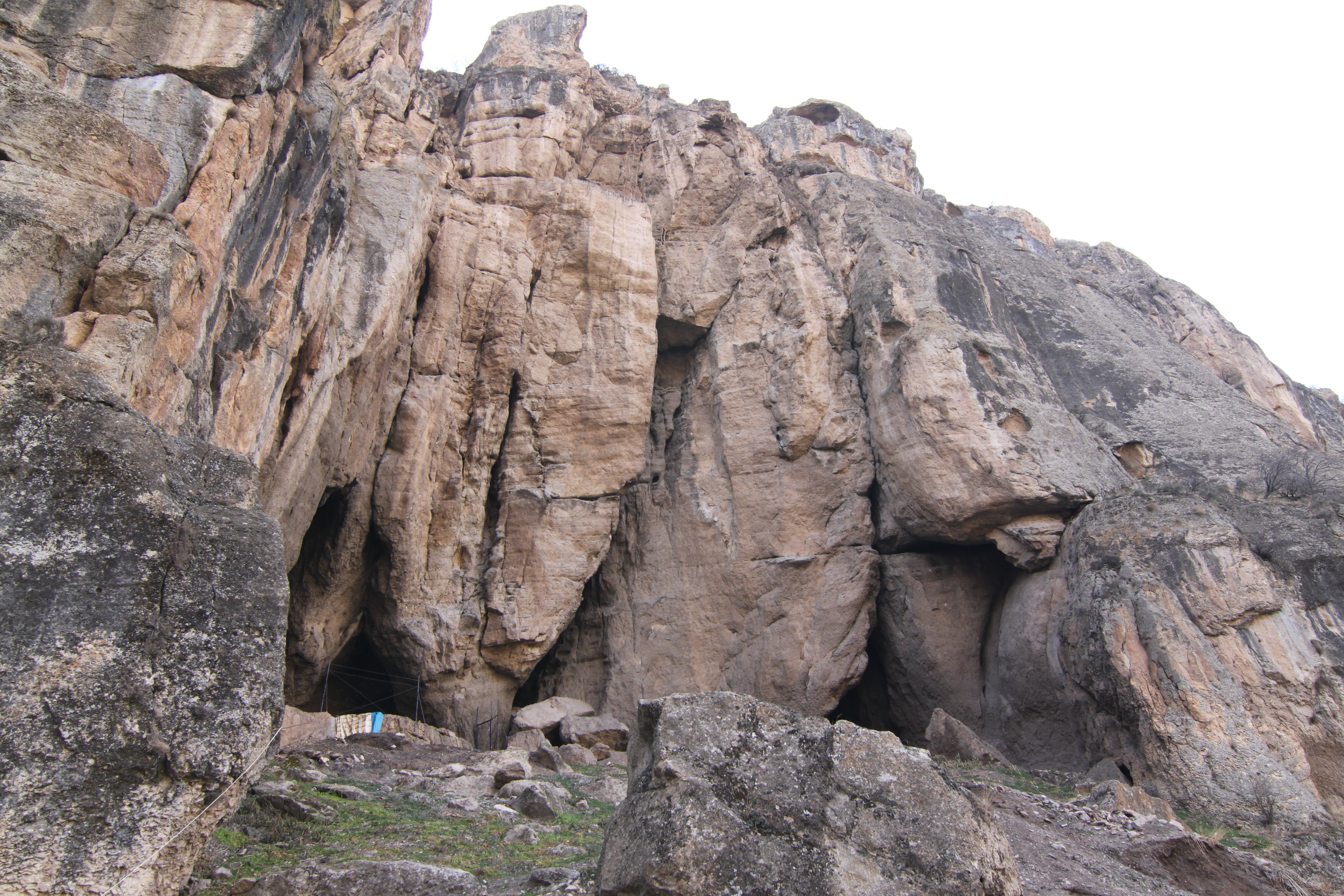
"The terrain is very rugged, and there are many sharp stones and prickly bushes” in the terrain around the cave, he explained – and “we have found obsidian in the cave, which came from at least 75 miles [120 kilometers] away.”
But it doesn’t just tell us about the person who wore it. The Areni-1 shoe is a stark demonstration of both the great diversity of human cultures – joining as it does a very exclusive club of ancient and unique shoe designs and technologies – and also how similar we all are.
The shoe “immediately struck me as very similar to a traditional form of Balkan footwear known as the opanke, which is still worn as a part of regional dress at festivals today,” Elizabeth Semmelhack, a curator at the Bata Shoe Museum in Toronto, Canada, told National Geographic.
Others have compared the shoe to pampooties, worn for centuries in Ireland up until the modern age; you could even “make a case for this shoe [design] being a forerunner to the North American moccasin,” argued Rebecca Shawcross, a shoe historian at Northampton Museums & Art Gallery in the UK – “a design “which has gone on to be a popular shoe style, whose influences can be seen in shoes of today[:] deck shoes; soft, slipper-style shoes for men; and so on.”
Of course, whoever that shoe once belonged to could never have envisioned being such a global fashion influencer. They just wanted to keep their feet warm.
“They produced a fairly rugged piece of footwear,” said Michael O’Brien, an archaeologist at the University of Missouri in Columbia who did not work on the project. “[It] was ideally suited for their environment.”