Humans
 PUBLISHED
 1
1


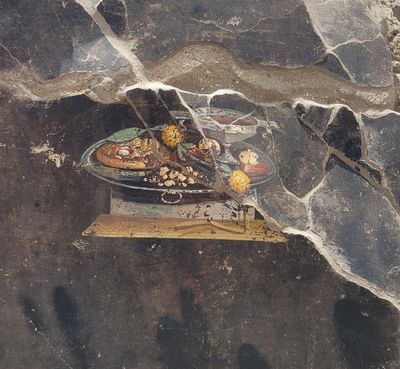


A vibrant painting has been unearthed among the ruins of Pompeii appearing to show a bundle of food and wine, including a distant ancestor of the modern-day pizza.
The fresco was found during recent excavations at a ruined house in the archeological site of Pompeii, the Roman town that was infamously wrecked by a devastating eruption of Mount Vesuvius in 79 CE.
The Pompeii Archaeological Park explains that the artwork consists of a painted still-life scene depicting a silver platter, a goblet of wine, and an array of fruits like dates and pomegranates.
The dish appears to show a flatbread covered in toppings, like a pizza. However, it can’t be considered a true pizza in the modern sense as it would have undoubtedly lacked tomatoes, which were only brought to Europe after the colonization of the Americas at the end of the 15th century CE.
In another allusion to the Mediterranean's rich culinary history, the painting also portrays moretum, a delicious spread eaten by the Romans that’s similar to modern pesto.

Researchers at the archeological park explain that these types of images were known in ancient times as “xenia” and were inspired by the hospitable gifts that were offered to guests in ancient Greece’s Hellenistic period (3rd to 1st century BCE).
Not only does this humble artwork show a clear Hellenistic influence on the Romans, but it also highlights how their food was a unifying force between the rich and poor, not dissimilar to some stables of Italian food today.
“In addition to the precise identification of the foods represented, we find in this fresco some themes of the Hellenistic tradition, later elaborated by authors of the Roman-imperial era such as Virgil, Martial and Philostratus,” Gabriel Zuchtriegel, the director of the Archaeological Park of Pompeii, said in a statement.
“I am thinking of the contrast between a frugal and simple meal, which refers to a sphere between the bucolic and the sacred, on the one hand, and the luxury of silver trays and the refinement of artistic and literary representations on the other. How can we fail to think, in this regard, of pizza, also born as a 'poor' dish in southern Italy, which has now conquered the world and is also served in starred restaurants,” Zuchtriegel added.
The ancient Roman city of Pompeii was decimated in 79 CE when the volcano Mount Vesuvius erupted, killing thousands of people in the city and nearby settlements of Herculaneum, Oplontis, and Stabiae.
One of the distinctive features of the eruption was the surrounding towns were shown in some 6 meters (19 feet) of ash and other volcanic debris. Devastating as it was, it preserved the settlements for centuries, providing modern-day revelers with an unbelievably clear insight into the daily life of ancient Rome.