Humans
 PUBLISHED
 3
3


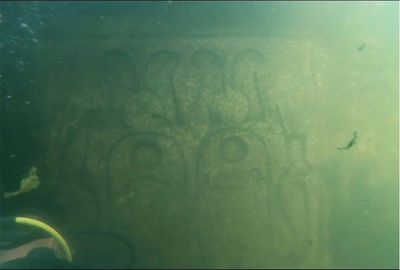


A joint Egyptian-French archaeological mission has uncovered stone inscriptions and other artifacts while conducting photographic survey work in Lake Nasser, Egypt.
The discoveries were found on submerged rock formations around the islands of Philae and Konosso, both of which are situated near the Nile’s First Cataract. These are basically shallow lengths of the River Nile that are characterized by rocky areas of boulders and islets that protrude from the narrow channels. There are six Cataracts in total, distributed between Aswan and Khartoum, in Sudan.
Before the Aswan Dam was constructed, the Cataracts were a significant hurdle for boats sailing on the Nile, as their shallower waters were essentially white-water rapids.
When the Aswan High Dam was built during the 1960s, the area around the islands of Philae and Konosso became flooded, leaving it under what is now Lake Nasser. The lake now covers a 5,250-square-kilometer (2,093-square-mile) area, which, at the time of its construction, threatened a region known for its rich cultural heritage. In particular, the area contained a number of important temples, including the famous Abu Simbel, as well as the Philae temple complex.
This led to the creation of the International Campaign to Save the Monuments of Nubia program, led by UNESCO.

During recent survey work, archaeologists with the Egyptian Ministry of Tourism and Antiquities in collaboration with Paul Valéry University Montpellier found the stone carvings, along with paintings and miniatures that depict Amenhotep III (who reigned around 1390-1353 BCE), Thutmose IV (reigned around 1401-1391 BCE), Psamtik III (reigned around 526-525 BCE), and Apries (reigned around 589-570 BCE).
At the moment, the Egyptian Ministry of Tourism and Antiquities has not specified what the inscriptions say or how the carvings appear. They have released a statement that suggests more information will be released in the future as part of a formal scientific publication on the subject.
According to the Ministry, the researchers have used “modern techniques” including diving, archaeological surveying, underwater photography and video, and photogrammetry, as well as classical drawings, to record and document the discoveries. The researchers are now working to create three-dimensional models of the inscriptions. The team also believe that more inscriptions and other historical information related to the reigns of the pharaohs depicted at the site will likely emerge as their work progresses.