Humans
 PUBLISHED
 1
1


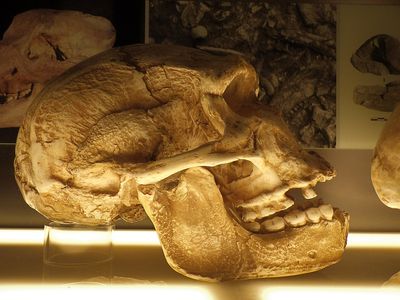


A statistical analysis of our closest extinct relatives has found our prehistoric ancestors underwent a bit of a growth spurt between 2 million and 2.5 million years ago, coinciding with an increase in meat-eating and two-legged walking.
Data from 2005 puts the average mass of a modern human at around 62 kilograms (137 pounds), but from what we can infer through fossil remains, the earliest members of our evolutionary clade – comprising anything carrying the genus name Homo – would have been a petite 40 kilograms (88 pounds), give or take.
It's clear then that we've gotten bigger over time, but according to the researchers behind this new study, palaeontologists still aren't in agreement about what that increase in size looked like: did it follow a steady upward slope, or did it feature some stepwise jumps?
"For years, different studies have come to different conclusions about whether our ancestors steadily grew bigger over time or jumped in size at some key point", Jacob Gardner at the University of Reading said in a statement.
"We think that's because everyone was looking at slightly different pieces of a much bigger puzzle. When you put all the fossils together, examine multiple competing ideas, and account for how species are related to each other, a clearer picture emerges. The answer is most likely a combination of these ideas."
Gardner and his colleagues based their work on 386 specimens covering 21 species of hominin spanning from early members like Homo habilis, which was widespread across Africa some 3.5 million years ago, to ourselves.
Other researchers had previously estimated our ancestors' body mass from these specimens, but because many are just fragments of a full skeleton, the estimates are based on different bones or teeth and use different methods, introducing a lot of uncertainty into the data.
To try to account for that, Gardner's team ran a series of 1,000 statistical models incorporating many different plausible values for the masses, as well as accounting for disagreements over the evolutionary relationships between the specimens. Some of these models incorporated stepwise jumps, while others did not.
When a jump was included after Homo habilis – one of the earliest and most primitive members of our genus – it explained 11 percent more of the observed trend in mass data than a model without it, on average.
That would suggest there was a distinct increase in size around the time of the emergence of Homo erectus and Homo ergaster, some of our first ancestors that spent significant amounts of time on two legs around 2 million years ago.
"This change coincided with broader developments in how our ancestors moved across landscapes and exploited their environments, pointing to a close relationship between body size and major ecological and behavioural transitions," said Thomas Püschel at the University of Oxford, who also worked on the study.
While less strong, the modeling also supported a general ongoing size increase across all hominin species on average of up to 0.99 kilograms (2.2 pounds) per million years.
That pattern is consistent with what biologists call Cope's rule, the long-observed tendency for animal lineages to get bigger over evolutionary time. This is often attributed to larger bodies conferring advantages in competing for mates, fending off predators, and regulating temperature, though the rule is far from universal and its underlying causes remain debated.
Indeed there were some key outliers even in this study. Homo floresiensis – sometimes nicknamed the "hobbit" – and Homo naledi were both significantly smaller than the model predicts, suggesting that body size evolution in our lineage was far from a one-way ratchet.
"The human story is not simply one of constant growth, but also of a major change that happened later, within our own genus, while other branches of the family, including some surprisingly small relatives, went their own way entirely," Gardner said.
The study is published in the Proceedings of the National Academy of Sciences.