Humans
 PUBLISHED


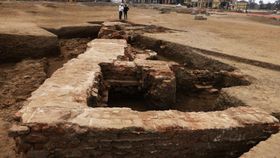


Archaeologists have recently unearthed a treasure trove of ancient goodies at the Sa El-Hagar excavation site in the fertile Nile Delta of Lower Egypt, according to an announcement made by Egypt’s Ministry of Antiquities last week.
Inside the ancient remains of a vast red-bricked building, they discovered a huge collection of gold coins, bronze tools, pottery vessels, hieroglyphic-engraved stones, and a terracotta statue of a ram (pictured below). Dr Ayman Ashmawy, Head of the Ancient Egyptian Antiquities, believes the 16-meter-long (52-feet) structure was a part of a bathhouse dating back to the Greco-Roman era.
A more precise dating was made thanks to a gold coin depicting King Ptolemy III, who ruled Egypt from 246 to 222 BCE, with a particularly spiky-looking crown. On the other side of the coin, there's a symbol that appears to be a cornucopia, also known as a horn of plenty, an emblem used in classical antiquity and the present-day to symbolize prosperity and nourishment.

The coin is believed to have been forged during the reign of his son, King Ptolemy IV, who commissioned the coins in memory of his late father. It might be over 2,000 years old, but it’s still got its shine.
Alexander the Great conquered Egypt in 332 BCE, bringing a dose of Greek culture to the land. One of Alexanders seven “bodyguards”, Ptolemy was set up as the governor of Egypt, establishing the Ptolemaic dynasty that ruled until around 30 BCE when they were eventually toppled by the Romans. The end of this period is most widely known by the story of the dynasty's last and notable ruler, Cleopatra VII. As famously depicted in two of Shakespeare's tragedy, she was an esteemed diplomat and lover of Roman leaders Julius Caesar and Mark Anthony.
The past few years have seen a constant stream of ancient treasures being unearthed by Egypt’s Ministry of Antiquities. Just this month, they concluded an ambitious project that hoped to settle rumors of a hidden chamber behind the tomb of King Tutankhamun. The final conclusion of the survey came as a huge surprise to the Egyptologists and archaeologists who made the sensational and controversial claim.
Check out some of the rest of the team's recent discoveries in the images below.