Space and Physics
 PUBLISHED
 1
1


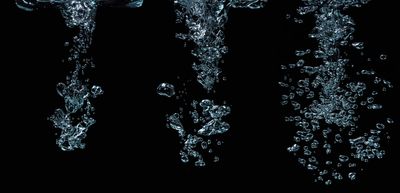


If you’ve ever watched air bubbles rising through water, you may have pondered the same thing as Leonardo Da Vinci: why don’t all of them travel straight to the surface? If so, you were more than 500 years too late, and probably insufficiently famous, for people to take much notice of your question, but the good news is you’re alive to get an answer.
The most curious thing about Leonardo’s observation is that it is only the larger bubbles that zig-zag or spiral to the surface, not the small ones, even though the same physical forces are acting on each.
In Proceedings of the National Academy of Sciences, Professor Miguel Herrada of the University of Seville and Professor Jens Eggers of the University of Bristol provide an answer to this conundrum, one they hope will lead to new advances in understanding liquid/gas interfaces.
Herrada and Eggers noted that not only has bubble movement never been explained, but it also hasn’t been mathematically described.

The authors observe a number of aspects of bubble movement which make them difficult to model, despite how common the phenomenon is. Most importantly they write: “The bubble deforms in response to the forces exerted by the fluid, and in turn, the shape of the bubble changes the character of the flow.”
Experiments have their own problems since even tiny contamination with surfactants such as soaps can affect bubble behavior.
Undaunted, Herrada and Eggers applied mathematical models and compared their findings with previous experiments done in “hyper-clean water”. They found rising bubbles undergo a periodic tilt that changes their shape. The side pointing up has higher curvature, which makes the surface more slippery, so water moves over it faster. This, by Bernoulli’s somewhat counterintuitive principle, lowers the pressure on that side, pushing the bubble back to its original position before the cycle starts again.
The modeling predicts this process should cause bubbles with a radius of more than 0.926 millimeters (0.04 inches) to wobble, deviating from a straight trajectory. The crucial size is within 2 percent of the value obtained in the ultraclean water.
The authors suggest the next step is to study how contamination affects the results. If hyper-clean water had been available in the 16th Century fewer people might have died from drinking it, so it’s reasonable to assume Leonardo made his observations while dealing with a certain level of impurity. Even today, very pure water is rare outside the lab, so this sort of extension is probably necessary if there are to be practical applications of the work.
The paper is open access in Proceedings of the National Academy of Sciences.