Technology
 PUBLISHED
 1
1



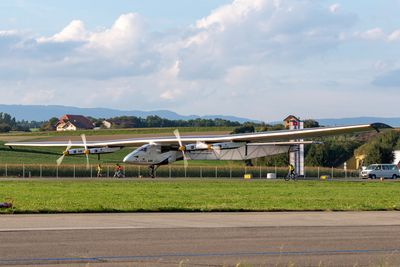


On May 4, 2026, the experimental solar-powered aircraft, Solar Impulse 2, crashed into the Gulf of Mexico during an autonomous test flight. Thankfully no one was hurt during the incident, but it does mark the end of the extraordinary story of this unique aircraft.
According to a National Transportation Safety Board report, Solar Impulse 2 had set off from Stennis International Airport (KHSA), in Kiln, Mississippi. But somewhere along the lines it reportedly lost power and crashed over the Gulf of Mexico where it was destroyed.
This is a sad end to a remarkable piece of technology. Construction of the plane started in 2011. It had a wingspan of 72 meters (236 feet), which is wider than a Boeing 747; but despite its large size, it only weighed around 2,300 kilograms (5,100 lbs). This is about the same as a typical SUV. It was powered by around 17,000 solar cells that were positioned across its wings, which allowed it to fly at a modest 47 miles per hour (75 kilometers per hour) on average.
In 2015, Solar Impulse 2 set off on a record-breaking mission to be the first solar-powered aircraft to circumnavigate the Earth. It set off from Abu Dhabi on March 9 and returned there a year later, on July 26, 2016. It was an incredible 17-leg journey spanning over 25,000 miles (40,000 kilometers).
Piloted by Bertrand Piccard, grandson of Swiss deep-sea pioneer Auguste Piccard and son of Jacques Piccard – one of the first people to reach the seafloor in the Mariana Trench – had originally envisioned that the plane would raise awareness of sustainable energy.
“With Solar Impulse, our aim is to encourage the deployment of clean technologies everywhere,” Piccard said in a statement prior to setting off in 2016. “If an airplane can fly day and night without fuel, everybody could use these same efficient solutions in their daily lives.”
During the trip, the plane was grounded in Hawaii for nine months due to seasonal changes that limited the amount of sunlight to below what it needed to continue.
Throughout the journey, Piccard was confined to a 3.6-meter (130-cubic-foot) unpressurized cockpit. It was equipped with provisions, equipment, and an oxygen reserve that allowed the pilot to travel long distances without stopping.
In 2019, Solar Impulse 2 was sold to Skydweller Aero, who wanted to explore the potential for the plane and others like it to be used for military surveillance. This included serving as the basis for the development of “autonomous drones, capable of continuous flight, for surveillance and telecommunications purposes,” Swissinfo explained.
Although criticized for its sudden about-face from sustainable future to military surveillance, Piccard defended the sale, stating that Solar Impulse 2 would not become a drone itself: “It is a plane that will never be armed. That is absolutely clear and it’s in the contract,” he said.
Skydweller has indicated it plans to launch a fleet of solar-powered drones that could fly nonstop at latitudes between Miami and Rio de Janeiro. The aim is for these technologies to be used for civilian, military or commercial purposes, including the detection of “drug smuggling and pirates at sea, providing continuous aerial coverage above war zones, surveillant naval activity in contested waters without risk” to a crew.
The loss of Solar Impulse 2 is a considerable blow for the aircraft company. “As part of its participation in the U.S. Navy’s Fleet Exercise (FLEX) 26, Skydweller Aero’s operational prototype aircraft conducted a historic 8-day (192-hour) and 14-minute autonomous maritime patrol flight,” Skydweller explained in a statement.
“The aircraft departed Stennis International Airport in Mississippi on Sunday, April 26, and remained on station providing multi-INT sensor capability through the conclusion of the exercise on Thursday, April 30, before executing a controlled water ditching in the Gulf of America on Monday, May 4.”
Following the exercise, the aircraft encountered poor weather conditions that demanded more energy than it would normally need to maintain altitude. This ultimately led to the “controlled ditch”.
“Based on observed system status, the aircraft remained under positive control by its onboard autonomous system through the final flight phase.”