Technology
 PUBLISHED
 1
1


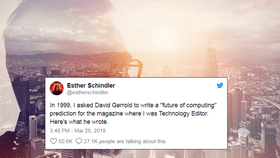


A prediction about future technology made in the late-1990s has gone viral because of its amazing Simpsons or Hitchhiker's levels of accuracy.
Back in 1999, tech editor Esther Schindler interviewed American science fiction writer David Gerrold for a prediction about the future of computing. A difficult thing to do, and you'd be tempted to keep it vague.
Gerrold instead was extremely specific, pretty much predicting smartphones, exactly how they would work, and how annoying we'd eventually find them.
He managed to predict that his phone would be merged with "a pocket organiser, a beeper, a calculator, a digital camera, a pocket tape recorder, a music player" and a color television, all fitting in a box smaller than a deck of cards.
He went on to predict how it would connect wirelessly and "function as a desktop system", as well as connect to full-sized screens and have speech recognition, act as a translator, and be used for emails.
For good measure, he predicted that it would also be used to book hotels.
Like all good sci-fi writers, he not only managed to predict the tech, but also the massive downsides that would come with it – mainly how annoying it would become.
"I call this device a Personal Information Telecommunications Agent, or Pita for short," he wrote. "The acronym also can stand for Pain in the Ass, which it is equally likely to be, because having all that connectivity is going to destroy what’s left of everyone’s privacy.”
People are impressed, particularly with his prediction about the device being used to destroy privacy.
Although he made a few notable mistakes...
He joins Nikola Tesla, Douglas Adams, and The Simpsons in being spookily accurate about what we can look forward to (or not) in the future.