Humans
 PUBLISHED


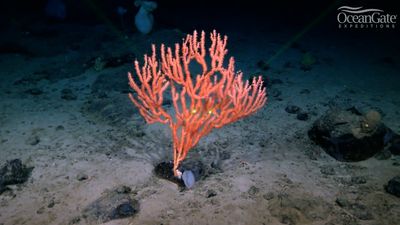


The cause of a puzzling sonar “blip” that has gone unidentified for 26 years has finally been solved. First noticed in 1998 by Titanic diver PH Nargeolet, the blip was seen neighboring the Titanic wreck 2,900 meters (9,514 feet) deep in the North Atlantic Ocean. First suspected to be a second shipwreck, OceanGate's 2022 Titanic Expedition has instead discovered a dense and lively ecosystem.
Provisionally named the Nargeolet-Fanning Ridge, after PH Nargeolet and Oisín Fanning, the OceanGate Expeditions Mission Specialist, the newly discovered geological feature is thought to be a collection of basalt volcanic formations
Incredible footage of the exploration of the ridge shows the area teeming with a host of marine life. “[W]e are astonished at the diversity and density of the sponges, bamboo corals, other cold-water corals, squat lobsters, and fishes,” said Dr Steve W. Ross, research professor at the University of North Carolina Wilmington’s Center for Marine Science and OceanGate Expeditions chief scientist, in a statement.
“Uncovering this previously unknown ecosystem also provides an opportunity to make a comparison to the marine biology on and around Titanic,” continued Ross. “The similarities and differences will help us better understand our deep-sea environments.”
Video footage, photographs, and water samples for environmental DNA analysis have been collected from the area. This will allow the extent of the biodiversity in the reef to be measured, as well as provide vital information into how deep-sea ocean life survives, thrives, and disperses.
“We need to share this information with the scientific community and policymakers to be sure these vulnerable ecosystems get the proper attention and protection they deserve,” said Dr Murray Roberts, Professor of Applied Marine Biology & Ecology in the School of Geosciences at the University of Edinburgh.
OceanGate’s research into the Titanic and surrounding area will continue in 2023, providing even more insight into the fascinating activities of these deep-sea environments.


 1
1