Health and Medicine
 PUBLISHED


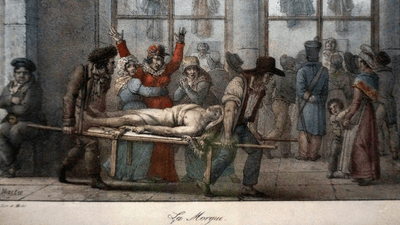


A display of corpses was a highlight for flâneurs passing the Paris Morgue in the 1860s. Captured by the “culture of looking”, the word “flânerie” was invented to describe aimless wandering as a way of taking in the city, and in the 19th century, that included ogling the dead.
The Paris Morgue had a salle d'exposition where its deceased residents would go on display so that the unnamed and unclaimed could be identified. The advent of the Industrial Revolution meant that many were traveling to the city for novel and sometimes dangerous avenues of employment. Those who perished in mechanical or locomotive accidents were often far from home, and they too would join the cold bodies waiting for personhood behind the glass.
It wasn’t long before the lost and found became a popular exhibit for the morbidly curious, even being listed as Le Musée de la Mort in British travel guides. Sitting behind the Notre-Dame Cathedral, the Paris morgue framed the corpses behind theatrically curtained windows, and depending on who was on display, it could draw in tens to hundreds of thousands of visitors, reports How Stuff Works.

It might seem crass, but as Taryn Cain points out for the Wellcome Collection, we have our own Paris Morgue in the modern era, and it’s gone global. The controversial Body Worlds exhibition displays plastinated cadavers that have been visited over 40 million times and even made it into a Bond movie. We might not be as far from La Morgue as we might like to think we are.
Back then, the corpses were fresh and dressed in nothing but strips of cloth to cover up key features, but their clothes were hung above them, providing a snapshot into the life of the deceased. As the French playwright Léon Gozlan said, “You go there to see the drowned as elsewhere you go to see the latest fashion.”
While the Musée Grevin was capitalizing on the appeal of the macabre by creating a “living newspaper” that staged waxen recreations of recent murders, it seemed the Paris morgue had gone one step further to satisfy people’s curiosity by providing them the horror in the flesh, as it were. The press was hot on the gruesome details of recent deaths, and the morgue provided readers the opportunity to connect with the story further by seeing the victims up close.

One particularly popular exhibit included “woman cut into two pieces,” who was retrieved in halves from the river Seine in 1876. Bodies eventually decomposed too much to remain on display, and after two weeks, she was replaced with a wax bust, drawing in hundreds of thousands of visitors.
According to JSTOR, the allure of la morgue may have had less to do with morbid curiosity and more to do with a sense of community, with visitors empathizing with the dead, rather than delighting in the horror of it all. As author of Spectacular Realities: Early Mass Culture in Fin-de-Siecle Paris, Professor Vanessa Schwartz of the University of Southern California wrote that the morgue exhibition hall and the waxwork living newspapers may have been 19th-century Paris’s answer to true crime documentaries.
But don’t get any ideas, Netflix.