Health and Medicine
 PUBLISHED


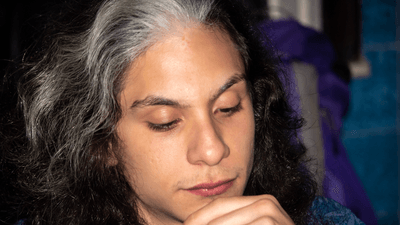


Growing up I always wished I could have hair like Rogue from X-Men. Rogue’s white streak was the result of a showdown with a powerful superhuman, but there’s another more earthly explanation as to why some people have similar streaks in their hair.
Known as a “Mallen Streak” (after the Mallen trilogy of novels by author Catherine Cookson), it presents as a localized patch that’s lacking pigment. That means someone with dark brown hair can have one streak of brilliant white running through it. Unlike graying hair where people experience a gradual loss of pigment across their head, a Mallen Streak affects a specific and defined area.
It’s the result of something known as poliosis, which is characterized by a patch or patches of hair that are lacking the pigment melanin. It most commonly affects the scalp, but can crop up anywhere on the body including eyebrows or eyelashes.
If you were to take some of the affected hairs and look at them under a microscope, you would see that they had little or no melanin or melanocytes in the hair bulb. The hair bulb is a club-shaped structure at the base of a hair follicle where new cells are formed. Think of it like the factory churning out your hair.
Melanocytes here decide the color of a hair, which is why it appears white for people with poliosis. There’s no white pigment within the hair, but the shaft is essentially colorless, so it appears white due to the way light reflects (fun fact: even polar bears don’t have white hair).
Poliosis can have genetic causes, meaning it's present from birth. For others, it can be acquired later in life. By itself it’s not considered harmful, and for many it’ll just be another unique trait about their specific body.
The condition is noteworthy for doctors, however, because in some instances it can be associated with other conditions. These include the autoimmune conditions vitiligo, which destroys pigment in skin cells, and alopecia areata that results in hair loss. Poliosis is also associated with a genetic condition known as piebaldism where melanocytes fail to develop across different areas of the body.
Piebaldism is well documented across many animal species, including elk and ball pythons. And speaking of animals with curious colorways, did you ever see this incredibly rare yellow penguin photographed in South Georgia?