Technology
 PUBLISHED
 14
14


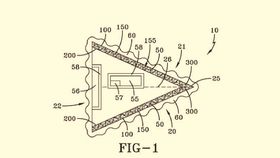


It’s a common piece of conspiracy theorist lore that the US government likes to keep tabs on UFO sightings, steal their alien technology, and use it for their fancy new aircraft. While we’d hesitate to comment on any of that business, it’s fair to say this patent from the US Department of the Navy certainly does smell a bit Roswell-y. Or, perhaps more likely, somebody in the US Navy watched too much Doctor Who one evening and wanted to make a flying saucer.
The US Navy appears to have filed a patent, available to view on Google Patents, in 2016 for an aircraft that can travel at “extreme speeds" using an "inertial mass reduction device comprises [sic] of an inner resonant cavity wall, an outer resonant cavity, and microwave emitters.” In other words, an aircraft that glides through space at high speeds like something out of Star Trek.
Remember, this is just a patent. It’s not clear whether the craft was actually ever tested at all – realistically, it looks doubtful that this thing was ever taken seriously – but here is how it's supposed to work.
Inertia is the tendency of an object to resist any change in a state of motion or, simply put, the tendency of an object to continue whatever it’s doing, whether that’s staying stationary or continuing to move in a straight line forward. Inertial mass is the measure of an object’s resistance to acceleration. So, if you could reduce an object's inertial mass, it would require less force to produce the same acceleration.

The aim of this craft is to reduce inertial mass by using high-frequency electromagnetic wave vibrations to create a localized vacuum around the outside of the resonant cavity wall. By doing this, so the idea goes, the craft could move through air or water, like a stone endlessly gliding along a frictionless sheet of ice.
“It is possible to envision a hybrid aerospace/undersea craft (HAUC), which due to the physical mechanisms enabled with the inertial mass reduction device, can function as a submersible craft capable of extreme underwater speeds… and enhanced stealth capabilities,” the patent continues.
“This hybrid craft would move with great ease through the air/space/water mediums, by being enclosed in a vacuum plasma bubble/sheath.”
Sure, it sounds impressive, but reducing inertial mass is not easy. It could potentially be achieved by altering the Higgs field, the field responsible for the mass of a particle, but there are currently no clues on how to do this. Who knows, perhaps some clues are laying around in a dusty old ranch in the desert of New Mexico...