Space and Physics
 PUBLISHED



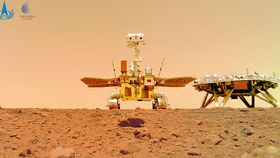


Zhurong, the China National Space Administration (CNSA) Mars rover, has been exploring the surface of the Red Planet for just over a year – a phenomenal result given that its original mission expected the rover to be roaming for around just 90 Mars days, or sols (92 Earth days). However, Zhurong is now facing its biggest challenge yet: survive the harsh winter on Mars.
On May 15, 2021, China became the second country ever to successfully land a rover on Mars. Since then the rover, named after a Chinese god of fire, has been exploring Mars’s Utopia Planitia, sending back pictures, exploring the topography of Mars, carrying out important science, and relaxing with the odd selfie.
Now, as reported by CNSA on Weibo, to survive the Martian winter the rover has hunkered down, entering hibernation on May 18.
The weather conditions at Utopia Planitia are not the best at the moment. A dust storm has severely reduced the ability to collect solar power, witnessed by the sensors on the rover and by the accompanying orbiter Tianwen-1 that flew overhead. It's looking like dust will be the thing to kill off another member of Mars's robotic population, NASA's InSight.
Temperatures are also a major problem. Currently, the maximum daytime temperature is less than -20°C (-4°F) but at night that drops down to -100°C (-148°F). And it’s going to get colder.
The winter solstice in the northern hemisphere of Mars is on July 26 and the little rover will then have to brace the 154 days of winter until early spring, which is set to begin on December 26, 2022. Around this time Zhurong will stretch its wheels and begin working once again.
In its extended mission, Zhurong has been reporting on some interesting features of the Red Planet including the possibility that liquid water was present for longer than previously thought.