Technology
 PUBLISHED
 1
1


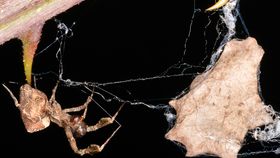


Researchers investigating cribellate spiders have discovered a unique comb structure that could help inform future equipment used to manipulate nanofibers. Nanofibers have been hard to handle in a lab setting as they can stick to the equipment attempting to manipulate them, but a new study published in the journal ACS Applied Nanomaterials reveals how spiders can help us to create non-stick tools for such scenarios.
Cribellate spiders are so named because of their unique web-spinning anatomy. Most spiders have a long single spinneret that they use to produce a single thread, whereas cribellate spiders have a silk-spinning organ. This organ acts like a plate with lots of small, ever so slightly raised protrusions, each of which produces a very fine silk just a few nanometers thick. The spiders then comb these thin fibers out using a calamistrum structure on their legs, producing silk with a woolly texture. This woolly-textured silk entraps the spider’s prey, but somehow, they are able to handle it without getting caught up in their own webs.
Nanofibers are a hot area of research right now but one of the difficulties in their handling is that they commonly stick to the equipment trying to manipulate them. Lead author Anna-Christin Joel, from RWTH Aachen University, and her colleagues wondered if the solution to this frustrating problem could be found within the silk-immune spiders’ anatomy.
Having identified the calamistrum comb as a key feature of the spiders’ spinning abilities, they decided to see what happened when this was shaved off. They observed that the silky-smooth, calamistrum-free spiders soon saw a buildup of nanofibers on their legs. Taking a closer look at the calamistrum, it was discovered that the surface of the comb was covered in fingerprint-like nanoripples that prevent the nanofibers from making contact with the comb’s surface.
They decided to try and replicate this non-stick surface by lasering similar patterns to those seen on the calamistrum comb onto poly(ethylene terephthalate) (PET) foils, which they then coated with gold. When tested for its anti-sticking properties, the artificial comb performed almost as well as the spiders’.
While the anti-adhesive surface is still being perfected, it’s hoped the discovery could provide a solution for handling sticky synthetic nanomaterials and nanofibers, making future research and innovation far easier.