Technology
 PUBLISHED



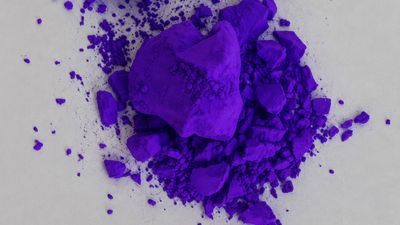


Usually, you would expect a darker-colored material to be worse at cooling you down because it should absorb more light and so heat up more. That's why walls and roofs in hotter countries tend to be painted lighter colors, and why wearing dark jeans on a summer day is a recipe for sweaty legs.
And yet, with just a little bit of materials-science know-how, some Nobel-Prize-winning chemistry, and a helping hand from the cooling powers of outer space, it turns out it's possible to stay cool in any color you like (so long as it's purple, at least for now).
Researchers at Adelaide University in Australia and Zhengzhou University in Henan province, China, have designed a highly reflective textile that keeps you even cooler than wearing white despite being a glorious, rich purple.
"We have traditionally had to make a choice between cooling performance and appearance," said Jun Ma, at Adelaide University, in a statement.
"Our research shows that we can have both. We can make a fabric that looks purple, but at the same time reflects most of the sun’s energy and releases heat very efficiently."
The new material does this through a phenomenon called radiative cooling. Researchers have explored this concept for some time, and it works because Earth's atmosphere is transparent to the specific wavelengths of infrared light between 8 and 13 micrometers.
Cooled by space
If you were to emit any old infrared light towards the atmosphere, it is likely it would be reabsorbed by oxygen, nitrogen, or some other atmospheric gas floating around up there, and then emitted in all directions. This keeps all that heat energy within the Earth's system.
But infrared wavelengths between 8 and 13 micrometers will pass straight through the atmosphere and into outer space, leaving Earth far behind for maximum cooling power.
This even causes a counterintuitive situation where radiatively cooled materials can go below the ambient temperature of their surroundings. This is because they are thermally coupled with deep space, which is really, really cold (about 3 degrees above absolute zero, on average).
It's expected that as the world warms up, demand for coolant technologies will skyrocket (just look at this Google Trends search data for "air conditioning" in the UK over the past five years, and note the steep rise during this summer's series of heatwaves).
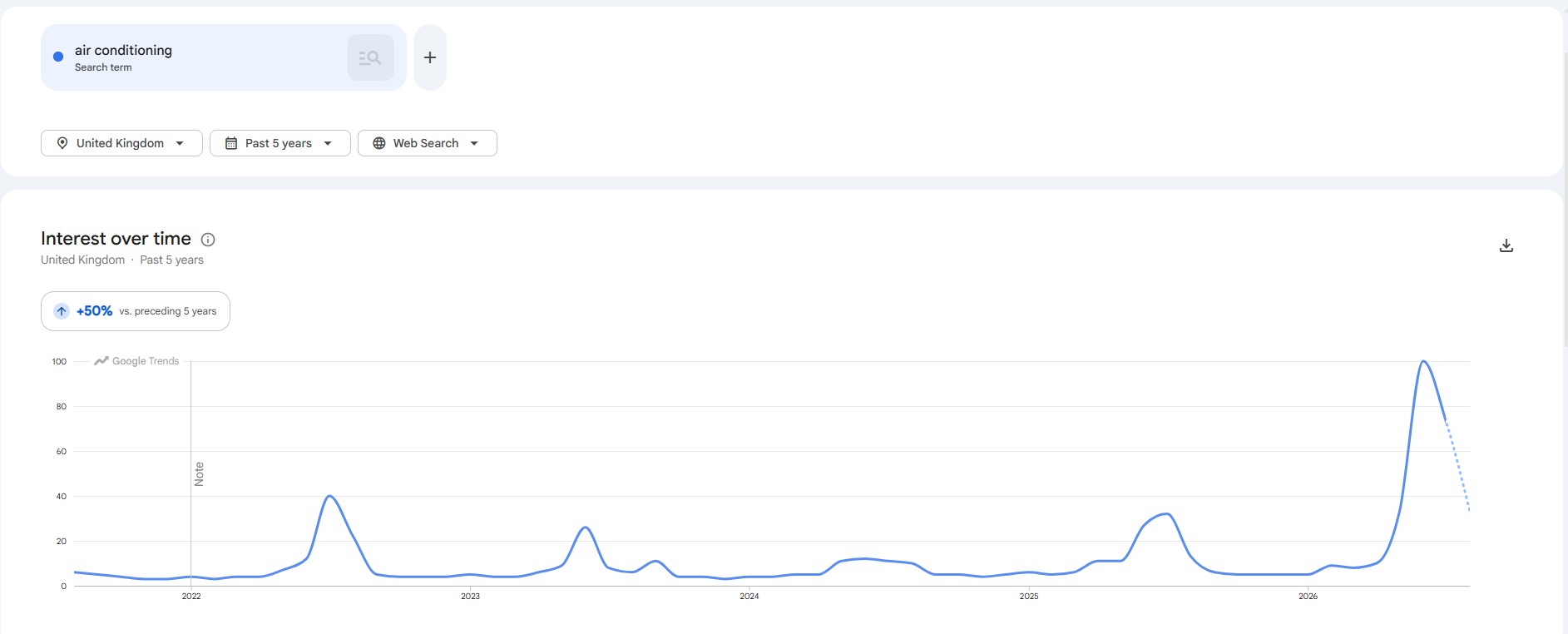
Powered air conditioning is energy hungry, however, and also a significant contributor to carbon emissions. If we can get passive radiative cooling to work, then it could be an ideal solution.
Adding color to cooling
There are lots of obstacles to widespread uptake of the technology, and one of them is that it is often restricted to being bright white and silvery, with no option to snazz it up with other colors. It's especially difficult to make a purple radiative cooling material because purple is caused by high absorption of green light, which is a major component of our Sun's spectrum.
To solve this issue, the researchers created the fabric using microscopic fibers doped with a purple material called a metal-organic framework (MOF), as well as zinc oxide nanoparticles.
MOFs are a versatile type of molecule in which metal atoms are connected to carbon-based molecules. Their inventors won the Nobel Prize in Chemistry in 2025, and they've been shown to have a great many interesting use cases, including passively harvesting water from the air.
The specific MOF in question here is called ZIF-67, and it works better than using a standard purple dye because, despite absorbing strongly in the green part of the visual spectrum, it retains high reflectivity for infrared radiation in that key atmospheric transparency window.
This means it doesn't reduce the material's radiative cooling potential.
In tests under direct sunlight in Zhengzhou, China, 5-centimeter by 5-centimeter squares of the purple fabric were 4.2°C (7.6°F) cooler than commercial white cotton and 6.2°C (11.2°F) cooler than commercially dyed purple cotton.
Of course, to work as clothing, a material must also be able to contend with the heat produced by the human body. When the researchers measured the temperature of "simulated skin" (pre-warmed to 37°C, 98.6°F) under the fabric, they found it was up to 8°C (14.4°F) cooler than when it was uncovered. That's compared with just 4.6°C (8.3°F) cooler white cotton and 2.8°C (5°F) for conventional purple cotton.
"For outdoor workers, athletes and anyone exposed to hot weather, staying cool is not just about comfort," said Yangzhe Hou, a PhD candidate at Adelaide University, in a statement.
"We are interested in developing fabrics that can help manage body temperature without consuming additional energy."
The researchers report that their material is of particular interest because it is lightweight and flexible, can withstand significant stretching, and allows water vapor to pass through, making it comparably "breathable" to regular cotton when worn.
The zinc particles also make the surface adopt a hydrophobic conformation, so it is water repellent, and retained its cooling performance after 50 wash cycles. It even withstood doses of UV equivalent to 108 days outdoors.
Making things scale
Still, radiative cooling materials have struggled to reach commercial viability for a number of reasons in the past. A review on the field in 2025 stated that whether the concept can move beyond theory into feasible applications is an open question, and it depends largely on being able to scale up production.
That said, there are already commercial operations using radiative cooling to reduce heat burden on buildings, including US company Skycool Systems.
MOFs are versatile in terms of their properties, so the researchers say their approach could be adapted to other colors by using different MOFs tuned to have different optical properties. Several other colored MOFs already exist, including brown HKUST-1(Cu) and cyan MOF-74(Ni), that could be used for this purpose.
If we're in for more high temperatures over the coming decades, this reporter, for one, is keen to get his hands on some space-cooled threads sooner rather than later.
A paper describing this research was published in the journal Small.