


 Health and Medicine
 PUBLISHED





What you'll discover in this article...
- A technique called DNA origami lets researchers build complex shapes out of DNA, and a team at the Salk Institute in California has used this to build a nano-sized helicopter rotor.
- The rotor allows researchers to visualize a process that has been difficult to view directly before: the relative rotation between DNA and the enzymes that decode it to make RNA and, eventually, proteins.
- Lead researcher Pallav Kosuri said: “We now regularly achieve higher resolution and higher throughput than any previous transcription tracking method that I know of. That allows us to discover rare but meaningful events while also backing up these discoveries with solid statistics.”
Researchers have developed a nano-sized helicopter rotor that lets them visualize spinning DNA molecules, revealing the hidden movements that lie at the heart of every cell and are fundamental to life.
We now regularly achieve higher resolution and higher throughput than any previous transcription tracking method that I know of.
Pallav Kosuri
The technique, called DC-ORBIT, builds on previous work by the same group, based at the Salk Institute for Biological Sciences in La Jolla, California.
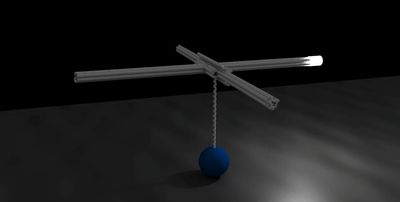
They've used a kind of molecular “origami” to build a miniature rotor that can be attached to a DNA molecule and amplify its rotational movement.
While an earlier version of this technique let them watch DNA spinning for a few seconds, the updated method extends that to at least 10 minutes, and the researchers report they have since made it work for hours at a time.
A new spin on things
DNA might not be known to most for its spinning, but rotation is actually an important property of the molecule. As enzymes travel along the double helix to read the DNA code – producing first RNA and then the proteins your body needs to do absolutely everything – they must follow the molecule's inherent twist, causing the enzymes and DNA to actually rotate relative to one another.
According to lead researcher Pallav Kosuri, understanding this movement is fundamental to understanding how this core biological process really works.
“If you don’t know how something moves, you don’t know what it does,” said Kosuri in a statement. “And if you want to understand, manipulate, and alter the function of molecules, understanding their physical movements is just as important as understanding their chemical reactions.”
“The difference is: We have a comprehensive catalog of the chemical reactions, while the mechanical side is still the Wild West.”
Not your average molecule
Kosuri told IFLScience that the standard way of tracking transcription – the process by which an enzyme called RNA polymerase produces RNA – is to stop the reaction periodically and measure the size of the transcribed molecules to see how many base pairs long they are.
This method makes it possible to see movements on a fundamental, molecular level.
Pallav Kosuri
The problem is that this doesn't monitor the process continuously, and measuring the lengths of RNA molecules requires taking a bulk average for all the molecules in the mixture. This “obscures the quirkiness of individual molecules,” Kosuri said.
“On a single-molecule level, the molecules might all be different, and the average behavior might not represent the behavior of any actual individual molecule.”
“To borrow an analogy that was once told to me by [Stanford researcher] Steve Block, if you measured the average path of ships going from the Pacific to the Atlantic Ocean, you would find an average path that goes through the Amazon rainforest. This is a common problem when measurements are done in bulk.”
Unfortunately, the diameter of DNA rotation is the width of the DNA molecule itself, which is 100 times smaller than the wavelength of visible light. This makes the rotation of an individual DNA molecule invisible to light microscopes. ORBIT works because the rotor amplifies the effective diameter, making it large enough to resolve.
“It’s as simple as attaching a larger object to a smaller object,” said Kosuri. “Now, when the smaller object rotates, we can see the larger object rotate, and record that in a standard microscope.”
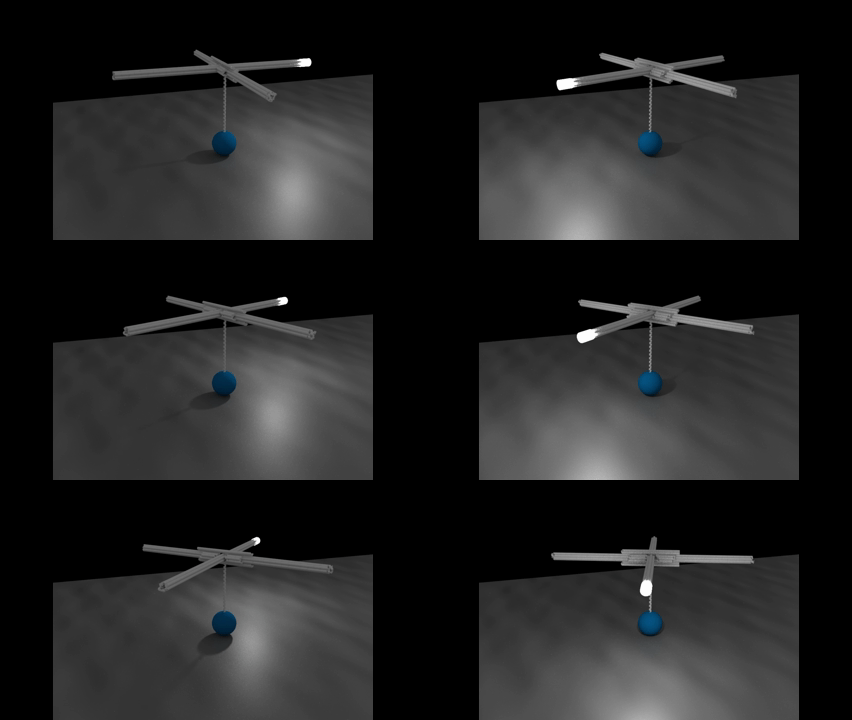
Curiously, the rotor itself is also made from DNA using a technique called DNA origami. Kosuri's group specializes in this work, and they previously collaborated with YouTuber Mark Rober to build the world's smallest Nerf gun out of DNA using the same method.
As the name implies, DNA origami involves folding a single strand of DNA into complex shapes. This is achieved using small lengths of DNA that bind to the longer strand at separate points, pulling them together to form loops. You can imagine it like building a sculpture out of wire or string held together at specific points by staples or zip ties.
The world's smallest corkscrew
In the Kosuri lab, they used this method to build an x-shaped rotor with 80-nanometer blades. The researchers describe the resulting structure as looking something like a wine-opener, with a corkscrew stem attached to an X-shaped handle. At the end of one rotor blade is a fluorescent molecule that can be seen through a microscope.
The structure extends the diameter of DNA revolution by 80 times without being too long and wobbly or introducing too much drag.
This meant the team could measure the rotation caused by a single RNA polymerase molecule as it moved along the DNA. The researchers stuck the RNA polymerase to a surface, then attached it to the long stem of the propeller.
As the RNA polymerase starts to process along the DNA, the propeller starts to spin. The method has enough resolution to identify the rotation caused when the polymerase moves by a single base pair, showing there is an average rotation of 35° per DNA base traversed.

The level of precision allowed the researchers to observe subtlety in the motion.
For example, they found that the rates of transcription varied between 0.07 base pairs per second and 4 base pairs per second. They also found that, while the average rotation per base was 35°, this also varied, which they hypothesize could reflect variation in the twist of the DNA depending on which specific base pairs are at that point.
“We now regularly achieve higher resolution and higher throughput than any previous transcription tracking method that I know of,” Kosuri told IFLScience. “That allows us to discover rare but meaningful events while also backing up these discoveries with solid statistics.”
The updated technique overcomes a persistent problem with fluorescent labeling that plagued the previous version, which is that the fluorescent molecules lose their potency after just a short time. If you think of the fluorescent molecules like lightbulbs, they have a tendency to blow.
With the new method, the researchers have essentially added a soup of free-floating fluorescent molecules – or lightbulbs – that temporarily stick to the rotor, such that there is always at least one working lightbulb attached to the structure at any one time.
“The only reason the mechanical side is a mystery is because we can’t see it,” adds Kosuri. “This method makes it possible to see movements on a fundamental, molecular level, and, by extension, I think the method could be used to understand the great unexplored universe of structural movements that happen in biology.”
The study is published in the journal Cell Reports Methods.



 2
2