


 PUBLISHED


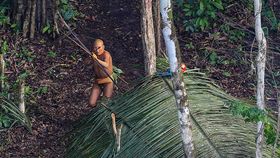


In 2008, photographs of an uncontacted indigenous tribe in a remote region of the Amazon rainforest provided definitive proof that, even in the hyper-connected modern world, there remain small communities of people living in complete isolation from what we call civilization. Now, new images of what experts believe to be the same group have revealed further details about their culture and way of life.
Brazilian photographer Ricardo Stuckert captured the images from a helicopter while on a research trip in the state of Acre, located in western Brazil, close to the border with Peru. Originally published by National Geographic, the images provide a closer look at the tribespeople, revealing their intricate body paint, varied hairstyles, and weaponry.

Members of the tribe grab their arrows after spotting the helicopter. Ricardo Stuckert
José Carlos Meirelles, who is also taking part in the research, told National Geographic that although the tribe was spotted in a different location to that photographed in 2008, it is likely to be the same group of people, adding that they appear to be semi-nomadic, moving every four years or so.
The pictures show a traditional thatched house known as a maloca, as well as some of the group’s weaponry, with one member of the tribe threatening the helicopter with a bow and arrow.
According to Stuckert, the members of the tribe were “more inquisitive than fearful,” and “there was a mutual curiosity” between the photographer and his subjects.

A tribesman strings his bow while several more look on. Ricardo Stuckert
However, despite the apparent good health of the tribe – which Meirelles estimates to include about 300 members scattered among various nearby settlements – anthropologists are concerned that illegal miners and loggers could soon encroach on their territory.
Previous instances of contact between westerners and tribespeople have had disastrous consequences, with the indigenous custodians of the Amazon forest invariably coming off worse. Outbreaks of diseases to which these people have no immunity, as well as violent clashes, have wiped out entire tribes in the past, leading to fears that history could repeat itself.
The pictured tribe are living in a protected territory, where heavy penalties are imposed on unauthorized invaders. Yet across the border in Peru, the situation is not policed quite as efficiently, and illegal activities are rife in many indigenous homelands. As the distance between the tribe and these unwelcome intruders decreases, the danger of extinction becomes ever more acute.

The tribe's maloca, surrounded by untouched Amazonian rainforest. Ricardo Stuckert
 A tribesman wearing intricate body paint prepares to defend the maloca. Ricardo Stuckert
