Health and Medicine
 PUBLISHED




How can you tell your body is your own? It’s so fundamental you probably hardly ever think about it, but from your brain’s perspective it’s a complex process – one a new study is helping to uncover.
“We have identified a fundamental brain process that shapes our continuous experience of being embodied,” said lead author Mariano D’Angelo, a researcher at the Karolinska Institutet in Sweden, in a statement.
To do this, D’Angelo and the team recruited 106 people to take part in an experiment involving the classic “rubber hand illusion”. Participants were seated in front of a table where a rubber hand was visible, stretched out in front of them like it was part of their body, while their own hand on the same side was hidden from view. The experimenter tapped the rubber hand at the same time that identical stimulation was applied to the participants’ real hand – which, remember, they can’t see.
As long as the stimulations exactly matched, the participants began to perceive the rubber hand as being physically attached to them. Then gradually, the experimenter introduced delays in the stimulation patterns so that this feeling eroded.
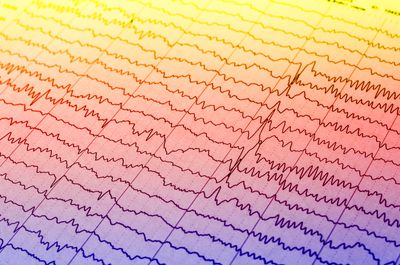
As the feeling of ownership of the rubber hand faded, the researchers had the opportunity to observe differences in the participants’ brain activity patterns using an electroencephalogram (EEG).
An existing theory in the fields of neuroscience and psychology suggested that alpha oscillations – rhythmic brain waves at a frequency of about 10 Hz – play a vital role in perception. For years, they were considered to be the brain’s “idling” signal, until evidence was uncovered suggesting they could actually be key to these essential processes.
D’Angelo and the team observed that individuals with faster alpha oscillations were most sensitive to changes in the timing of stimulation to their real hand and the rubber hand, noticing more quickly when the simulation was out of phase.
Those with naturally slower alpha waves, by contrast, took longer to perceive that the timing of stimulation had changed. Essentially, it took more to show their brains that they had been tricked into perceiving the rubber hand as their own. The team called this period the “temporal binding window”.
To confirm that it was the alpha waves causing this, they artificially sped up or slowed down participants’ alpha frequencies using transcranial alternating current stimulation (tACS), a form of noninvasive brain stimulation involving the application of mild alternating electrical currents to specific areas of the scalp.
By manipulating the alpha frequencies, the researchers could change how precisely the participants perceived stimulation to the rubber hand and their own hidden hand as simultaneous.
“Our findings help explain how the brain solves the challenge of integrating signals from the body to create a coherent sense of self,” said senior author Professor Henrik Ehrsson.
The findings don’t just help resolve the open questions around the importance of alpha waves. Understanding bodily perception has a range of applications – as Ehrsson suggested, these include “the development of better prosthetic limbs and more realistic virtual reality experiences.”
It could also help scientists seeking new treatments for conditions where the sense of bodily perception is altered, as D’Angelo explained: “The findings may provide new insights into psychiatric conditions such as schizophrenia, where the sense of self is disturbed.”
The study is published in the journal Nature Communications.