Health and Medicine
 PUBLISHED
 3
3


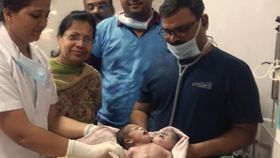


Conjoined twins with three arms, two heads, and a shared heart have recently been born in India. Babita Ahirwar, a 21-year-old, gave birth to the conjoined twins via C-section on Saturday, November 23, alongside her husband Jaswant Singh Ahirwar.
The parents, from the rural village of Basauda in the central Indian state of Madhya Pradesh, were initially shocked at the birth. Although the mother had undergone an ultrasound and was expecting twins, they were unaware they were conjoined twins until delivery.
Medically, this is known as Dicephalic parapagus, defined as a rare form of conjoined twins with two heads side by side on one torso. If the twins share three upper limbs, such as this case, it’s specifically known as Dicephalic parapagus tribrachius.
It’s thought that just one in 50,000 to 100,000 human births are conjoined twins. Due to the rarity, scientists know little about the condition. The leading theory says it’s caused by identical twin embryos that fail to separate shortly after fertilization, typically around the 8- to 12-day mark. Another theory suggests conjoined twins can result from an egg that first splits normally, but then joins back together.

It's also unknown whether certain factors can increase the risk of having conjoined twins, although researchers believe there might be some genetic and environmental component to the condition.
Unfortunately, this form of conjoined twins is extremely difficult to separate, primarily because they often share vital organs. The condition also comes with a huge host of potential complications that can threaten the lives of both twins.
The twins are currently under round-the-clock observation at Vidisha Sadar hospital and their doctors are weighing their options. However, as they are believed to share a heart, their prospect of a long and happy life remains small. Nevertheless, the twins' parents have vowed to do their best to take care of their newborn children.
“This is my baby and I will raise him as he is. I am yet to hold him in my hands,” said Ahirwar, the twins’ father, according to Caters News Agency.
“People are saying many things but he is my baby and I will take him home. As long as he is alive, I will love him and take care of him.”