Humans
 PUBLISHED


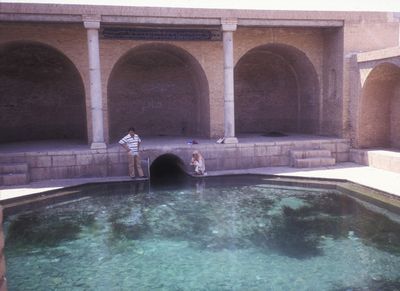


With the help of artificial intelligence (AI), spy satellite images from the Cold War are revealing the engineering mastery of ancient civilizations in the Middle East and North Africa.
In a new study, researchers at the Catalan Institute of Classical Archaeology have tested out a creative way to search for qanats, a system that dates back around 3 millennia that transports water from an underground aquifer to the surface.
Detecting these constructions isn’t always easy since they’re buried beneath the ground and only discernible by regularly spaced shafts visible from the surface. They are especially difficult to identify in regions of the world that are difficult to traverse due to extreme geography and volatile political situations.
In a push to overcome this difficulty, the archaeologists trained an AI algorithm to spot signs of qanats from aerial images, then applied it to black-and-white spy satellite images taken by the US in the 1970s over Afghanistan, Iran, and Morocco.
It was able to successfully identify the presence of the underground water tunnels with a precision of over 88 percent, much more effectively than previously tested methods.

In the future, it’s possible AI systems could be used to sniff out qanats in other parts of the world. It’s known the invention readily spread throughout the ancient world across the Middle East, Arabian Peninsula, and North Africa, even reaching as far as western China and Spain.
Arguably the best example of this engineering marvel exists in modern-day Iran, where the technology was invented over 3,000 years ago. Listed as a UNESCO World Heritage Site, the Persian Qanat is a complex system of tunnels that tap into the aquifers of nearby mountains and valleys, transporting water by gravity for many kilometers.
The advanced technology played an important role in the rise of the Persian Empire, complete with complex infrastructure and agriculture, despite being located in an extremely arid part of the planet.
Sadly, parts of this history are being lost at an alarming rate. The new research notes that many of the qanats seen in the satellite imagery from the 1970s have been “obliterated” during the last 40–50 years.
The loss points to a wider problem of the archaeological record being destroyed through urbanization, infrastructure development, and farming, as well as wind and water erosion. It has become a prominent problem in countries being impacted by war, creating fraught situations where historical relics are low on the list of priorities – or even become active targets of the conflict.
The new study was published in the Journal of Archaeological Science.



 8
8