


 PUBLISHED
 4
4


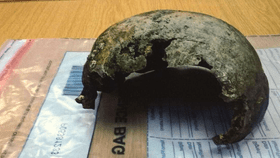


When you see an old football lying around on the beach, the natural instinct is, of course, to run up to it and punt it as hard as you can. However, you may want to think twice before you next try and wallop an abandoned ball, in case it turns out to be the skull of some Iron Age dude.
It sounds unlikely, but that’s just what happened when Anthony Plowright went for a coastal stroll with his dog last summer on the Isle of White, just off the south coast of England. Noticing an unclaimed spheroid lying in the sand, he did the right thing and gave it some welly, only to discover that things weren’t quite as they seemed.
“I thought it was part of an old football when I first saw it and so I booted it down the beach. I soon realised it wasn't a ball,” Plowright told the Isle of White County Press. “I put it in a bag and took it home and emailed the police to tell them I had found it.”

Isle of Wight County Press/Solent News. Used with permission from HMC for the Isle of Wight.
The unusual artifact was eventually sent to the local coroner's office, where it was identified as a human cranium, which is the upper part of the skull. When the old bonce was sent for carbon dating, it was determined to have belonged to someone who lived some time between 800 BCE and 540 BCE, during the Iron Age. Unfortunately, the partial skull was all that remained of the ancient skeleton, which means that whoever found it before Plowright must have kicked it pretty damn hard.

Isle of Wight County Press/Solent News. Used with permission from HMC for the Isle of Wight.
