Culture and Society
 PUBLISHED
 1
1




Nature versus nurture, an infinite debate. Genetics revolutionized our understanding of how our biology affects our lives, before epigenetics and recent trauma research entered the fray and showed us that our genes can be directly affected by our upbringing. Frankly, the answer is: we still have no idea.
This has led some people to wonder whether highly intelligent animals could achieve a similar level of intelligent behavior if raised like a human – and, as is the way for all shower thoughts, a team of scientists has been there, done that.
Intrigued by a case of two children who were raised by wolves and remained almost feral for their entire lives, Winthrop and Luella Kellogg (no, not the cereal guy) embarked on a wild experiment of their own. Winthrop Kellogg was a comparative psychologist and dedicated his life to understanding intelligent animal species during the early to mid-1900s, and ran an animal stimuli lab at Indiana State University before doing the same at Florida State University.
They had a son, Donald, who was in his infancy, and the married pair hatched a plan – they would raise an infant chimpanzee alongside Donald as siblings and monitor their development side-by-side. What better way to test whether chimps could act like humans, than by raising one as a human?
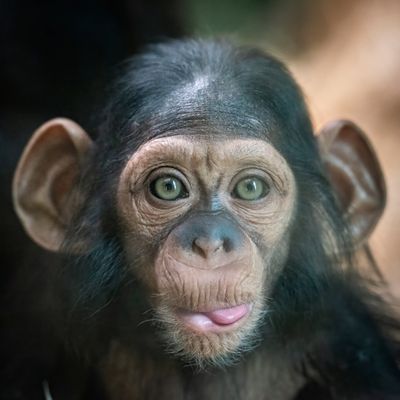
Meet Gua, a chimpanzee just seven and a half months old, that was taken in to the Kellogg household in 1931. Donald was just 10 months old by the time Gua was introduced to the family, so the two were almost identical in age. In the eyes of the family, Gua and Donald were brother and sister, and would be raised accordingly. She received constant attention, was given the same learning tasks an infant human would be, and even wore outfits and nappies for the nine-month study period.
A documentary was made comparing the two in different tasks, which can be seen below.
Gua developed well, gaining good motor skills and physical strength like any chimp in captivity would. According to a newspaper report, Gua walked upright and could respond to 20 simple commands, and was coined “smarter” than Donald at 12 months old.
However, differences quickly started to appear – while Donald would use physical appearance and faces to identify people, Gua would use smells and the clothes they were wearing. At 16 months old, Donald began forming words, but Gua could not. It seemed that while Gua excelled in early tasks, eventually, her brain simply could not keep up with the development of Donald’s.
As expected, having a chimp as a sister began to take its toll on Donald, and he began mimicking the sounds Gua was making. While the experiment wanted Gua to become more human, Donald was becoming more chimpanzee. Nine months in, the experiment was halted.
Gua was returned to the Yerkes Regional Primate Research Center in Florida, where she was further studied until her death less than a year later due to pneumonia.
While unorthodox and highly unethical by today’s standards, the study revealed some fascinating conclusions. Animals are far more intelligent than we often gave them credit for, particularly during the 1900s, but that development only seems to take them so far. Some primates have even been shown to carry the vocal capabilities to form words, but they lack the brain development to cross that bridge.
So, there we have it - while they are as smart (or even smarter by some metrics) than humans up to a point, evolution has delivered them to a different fate and chimpanzees cannot be raised human.