


 PUBLISHED


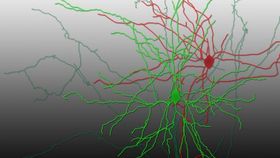


The rising field of optogentics has been used to record synaptic transmissions in a live animal brain for the first time. The achievement could open the way to powerful tools for studying the brain, and potentially ways to manipulate the brain's functioning.
Optogenetics involves the use of light to control neurons that have been sensitized with proteins to respond to electromagnetic radiation. In the last decade it has allowed researchers to observe the behavior of individual neurons in living animals.
A gene for the production of a light-sensitive protein is inserted into one or more neurons. The protein serves as an electrical channel on the surface of cells, allowing entry to ions when triggered by light. The entry of sufficient ions will in turn trigger an electrical signal. While such signals are the method by which neurons communicate with each other, the capacity to trigger the signal on demand provides unprecedented opportunities to study the workings of the brain and spine.
In Neuron Dr Aurélie Pala of the École Polytechnique Fédérale de Lausanne describes how she stimulated individual neurons in the barrel cortex of anesthetized mice. The barrel cortex processes sensory information from the whiskers.
“Few studies have directly investigated synaptic transmission between identified neocortical neurons in vivo, presumably due to the technical difficulties in obtaining intracellular recordings from connected pairs of neurons in vivo,” Pala writes. However, she notes, “Our results largely agree with in vitro measurements.”
Pala tracked the electrical signals in neighboring neurons when she shone blue light on sensitized neurons, allowing her to see the ripple effects of a single neuron's stimulation. She observed that the transmissions varied according to the type of interneuron, or relay neuron, receiving the signal.
"This is a proof-of-concept study," says Aurélie Pala, who has plans to map the neuronal connections of the barrel cortex, as well as repeating the study in undrugged mice. "Nonetheless, we think that we can use optogenetics to put together a larger picture of connectivity between other types of neurons in other areas of the brain."
Ultimately the technique could be used to explore more advanced brain processes such as cognition. The research formed the basis of Pala's PhD.
