Health and Medicine
 PUBLISHED
 6
6


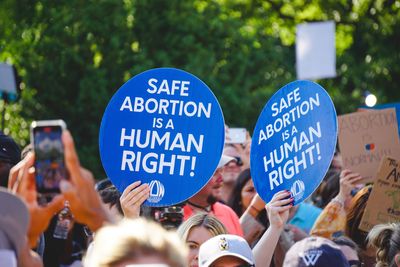


Abortion bans may nominally be an effort to preserve life, but their practical effect is quite the opposite. That’s the finding of a new paper from scientists at the University of Maryland and the Women and Infants Hospital of Rhode Island, which confirms that between pregnancy and abortion, the former is the more dangerous to life.
“The research found that the mortality risk from pregnancy (including up to one year postpartum) is 44 to 70 times higher than the mortality risk from abortion,” Maria Steenland, assistant professor at University of Maryland’s School of Public Health and a lead author of the study, told IFLScience.
“The implication of our findings is that taking away the option to end a pregnancy exposes pregnant people to much greater risk of death.”
It’s been around four years since Dobbs v. Jackson Women’s Health Organization, the landmark Supreme Court case that overturned Americans’ right to abortion – and since then, pregnancy in the US has gotten markedly less safe. Women in states with abortion bans are at best almost twice as likely to die during pregnancy, while giving birth, or within the postpartum period, than their peers in states where abortion is allowed; in some states, particularly for Black women and girls, pregnancy can be around six times more deadly than elsewhere.
Taking away the option to end the pregnancy is dangerous for pregnant people because the health risks of childbirth are so much greater than the risks of abortion.
Dr Maria Steenland
It's far from a pretty picture – but neither is it surprising. It’s long been known that pregnancy is more dangerous than an abortion: “A commonly cited statistic […] is that the risk of death associated with childbirth is approximately 14 times higher than that of abortion,” the paper points out.
But that statistic, while stark, is not all that current. It dates from 2012 – a time when abortion was legal throughout the US, and the national maternal mortality rate was … well, slightly better than it is today, actually. What would the same type of study conclude today?
“The lowest estimate (44 times higher) is three times higher than what was previously estimated,” Steenland said – an increase which is, she explained, mostly due to “improvements in data collection to identify pregnancy-related deaths,” although the increasing safety and early timing of abortions over the past decade and a half also plays a part.
But not all of the increase is from such benign sources. Some “was driven by higher pregnancy-related mortality rates,” Steenland told IFLScience – though, she cautioned, “our study does not provide any evidence on the reasons for these changes.”
But therein lies the rub. Worsening maternal mortality rates notwithstanding, more accurate maternal monitoring, earlier pregnancy detection, and safer abortions are all undoubtedly good things – but only if you can actually access them. Since Dobbs, that’s all been thrown into question.
“Evidence indicates that the Dobbs decision was associated with an increase in births in states with abortion bans, suggesting that bans have forced some people to remain pregnant who would have otherwise sought abortion care,” the paper points out. “In the post-Dobbs environment, such individuals face a substantially greater mortality risk because they remain pregnant despite initially planning for an abortion.”
Precisely how much of an increased risk may be difficult to figure out, however. As they remove access to abortions, several states have also delayed or disbanded their Maternal Mortality Review Committees, the authors note – and even those that survive are not beholden to some nationwide standard of reporting.
That is a limitation of the study already, the authors admit, as is the fact that a supermajority of the Centers for Disease Control and Prevention’s Division of Reproductive Health was eliminated last year by Trump and RFK Jr’s Department of Health and Human Services.
Overall, however, the potential for tragedy is clear.
“Many factors influence pregnancy and abortion-related mortality beyond access to abortion,” Steenland said, “and our study does not provide enough information to be able to predict future outcomes.”
Nevertheless, she said, “the main point that we want to make in this study is that taking away the option to end the pregnancy is dangerous for pregnant people because the health risks of childbirth are so much greater than the risks of abortion.”
The study is published in the journal JAMA Network Open.