


 PUBLISHED


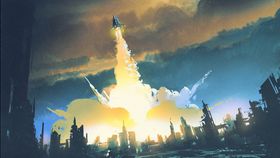


Despite a narrative richly filled with new worlds, exotic creatures, and impossible travel over vast distances, a new study claims that science fiction novels trigger “poorer overall reading”, but only for those who might already cast shade on the genre.
The research has been published in the journal Scientific Study of Literature, and attempts to quantify whether or not someone who reads a text that is based on science fiction deems it less worthy, and thus pays less attention to it, compared to when they read a literary fiction where they may try harder to understand the main protagonist. It seems, however, that there might be a self-fulfilling bias involved.
The study tests how both literary fiction and science fiction impact the “theory of mind”, in which readers have to work out what the characters are thinking and feeling based on inferences, rather than being explicitly told, as well as the “theory of world”, where a reader has to figure out the social conventions and physics of the world that the characters inhabit.
The participants were asked to read one of two 1,000 word texts. Both versions were identical in terms of the main story, in which the protagonist has his negative opinions of a community made public, before walking into a public eating area and interacting with other characters.
In the literary version, the character wakes up in his house, before making his way to a diner. In the science fiction text, however, the protagonist wakes in a bunk on a spaceship, before walking into a dining room that's filled with humans, aliens, and androids. Both are effectively the same piece of writing, except for the “setting creating” words, such as “door” and “airlock”.

The researchers argue that this meant that readers should have been able to understand the motives of characters and have empathy towards them – that theory of mind – equally well. On the other hand, it should also have meant that the theory of world was significantly easier for the readers of the literary work as it matched their own experiences, while those with the sci-fi text would have had to use it to a greater degree.
But this is not what happened. They found that the science fiction work cut a reader's perception of literary quality, and as participants focused on figuring out the new world, this impacted how they empathized with the characters. But the authors argue that this is down to an implicit bias in readers who expect sci-fi to be of a lower quality and less “literary” than other novels, even if the contents are basically the same.
They do admit, however, that this isn’t necessarily true for all readers, and is far stronger for those who are already prejudiced towards sci-fi. They say that readers with this bias will read a word like “airlock” and make an assumption that the work is not worthy, and thus read poorly, lowering their comprehension of the text. They then report that the work is not as good.
“So, no, SF doesn’t really make you stupid,” study author Chris Gavaler told The Guardian. “It’s more that if you’re stupid enough to be biased against SF you will read SF stupidly.”
