


 PUBLISHED
 3
3


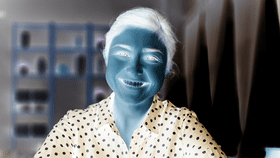


Everyone loves a good optical illusion (who doesn't like realizing that their own senses are unreliable and worthless?) and this one is no exception.
"You're about to experience a negative afterimage," clinical psychologist Dr Julie Smith explained in a widely-viewed TikTok video. "I'm going to trick your brain into seeing color where there is none.
"By focusing on the cross your brain is going to do something incredible. Overexposing the receptors in your eyes to certain colors causes the brain to see inverted colors when the black and white image appears."
If you follow the instructions, sure enough, you will see her in full color, even though the video remains in black and white.
Negative after images, such as you saw above, are created when you stare at a stimulus for a prolonged period of time. As you stare at the stimulus, your cones become desensitized to colors and send a weaker signal. The easiest way to demonstrate this is for you to stare at the blue splodge in the image below until the surrounding area appears to fade away completely (until you blink or look away, that is).
That's known as the Troxler effect after the man who discovered it. In the inverted color illusion demonstrated by Dr Smith, your desensitized cones are sending out a weaker signal than the surrounding cones, having stared at the inverted image for so long. Your other photoreceptors are firing as strongly as ever, having not been stimulated.
But, you'll notice, there's still no color for them to be stimulated by either, so why do you see color?
According to the opponent process theory of color, your perception of color is controlled by an antagonistic mechanism. There are three opposing channels in your vision:
- Blue versus yellow
- Red versus green
- Black versus white
The channels can combine, for example, you can see a bluey-green or a yellow-red, aka orange, but you can only perceive one of the colors in each channel at a time. I.e. you never see a reddy-green or a yellowy-blue.
Back to the illusion. In portions of the inverted image that are green, your cones become desensitized to that color and send out a weaker signal. As the image switches to black and white, the opposite photoreceptor – red in this example – is still firing strong signals. The lack of green tricks your brain into thinking you are seeing red, when you aren't.
Given that the entire image was inverted, it essentially turns the negative image into a positive one in the afterimage, at least for a very short amount of time.
