


 PUBLISHED


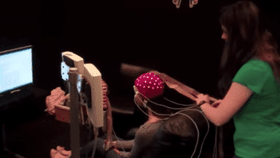


A new light has been cast on one of philosophy's most profound debates: Do we have free will, and if so where does it come from?
Free will seems pretty obvious. When we make a decision we feel like we're actually making a choice, not as though a confluence of our genetic inheritance and environmental factors have made it inevitable that we will take the path we do. However, whether this is really the case is much less clear. The more we learn about the factors that cause people to act in certain ways the easier it is to question if there is any choice involved.
Dr Jesse Bengson of the University of California, Davis claims to have found an answer. In the Journal of Cognitive Neuroscience Bengson reports on a study into the “background noise” of fluctuating electrical activity patterns in the brain. He notes that this noise means, "a neural system may generatetime-varying outputs (e.g., percepts) though the input does not change."
Bengson monitored 19 volunteers brains with electroencephalography (EEG) machines while they chose arbitraly to look either left or right when a cue appeared on a screen in front of them. They were instructed to choose randomly had no knowledge of when or where on the screen the cue would appear.
Unable to prepare for the cue, the volunteers would not have had a conscious decision that could be tracked via EEG. Despite this, Bengson found that looking at the pattern of brain activity 0.8 seconds before the cue appeared was a good predictor of which way the subject would choose to look.
"The state of the brain right before presentation of the cue determines whether you will attend to the left or to the right," he said.
Bengson sees a sort of free will in his findings, "A broader implication of this finding is that the appearance of free will, as manifested through seemingly arbitrary cognitive decisions, may be a consequence of the role that inherent variability in brain activity plays in biasing momentary behavior." Begson says the work, "Inserts a random effect that allows us to be freed from simple cause and effect." However, others have already considered this and objected. Even if our decisions are not deterministic, are we really free if controlled by random fluctuations? Nevertheless, if Bengson are right, at least we are not mere puppets acting out an inevitable play..
The study builds on one conducted in the 1970s, also at Davis. In this Benjamin Libet measured the brain waves of people given a switch and asked to choose when to press it. Libet found that brain activity preceded the volunteer reporting his or her decision, raising the question of whether there was a delay in the volunteer's reporting, or if brain activity beyond the subject's awareness drove the decision.
