


 PUBLISHED
 2
2

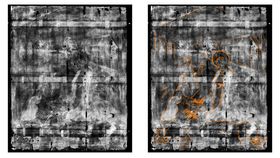


There is so much more than meets the eye with one 16th-century painting currently housed at England’s Bowes Museum. An X-ray has revealed an image hidden under the layers of paint depicting what appears to be a nativity scene, complete with angels with halos, a baby in a manger, and the outline of what may be a stable building.
“We’re simply delighted and astounded to discover that this 16th-century work was hiding such a wonderful secret and to find out at this time of year is really quite fortuitous. It’ll be really interesting to find out more about it as Northumbria University continue their investigations,” said Dr Jane Whittaker, The Bowes Museum’s head of collections, in a statement.
The overlaying painting depicts the beheading of Saint John the Baptist, a Jewish preacher and profit who is known for baptizing Jesus, according to History. He was beheaded for condemning King Herod the Great’s marriage to his wife, who had formerly been married to his brother, as told in the Gospels of Matthew (Matthew 14:1–12) and Mark (Mark 6:14–29). The painting shows John the Baptist and his executioner just moments before his beheading.
“It was such a lovely surprise to see the nativity scene revealed underneath the painting we see today,” said Nicky Grimaldi, senior lecturer in Conservation of Fine Art at Northumbria. “It really is quite unusual to find paintings hidden in this way and to discover a nativity scene in this detail and just before Christmas was really incredible.”

Experts at Northumbria University and the Bowes Museum were working to restore the 400-year-old painting when they discovered the underlying scene. According to the Bowes Museum blog, the medieval artwork was painted on a piece of canvas that was spread over wood, as was typical of the time. Over the years, the wood has been damaged and deteriorated, prompting art conservationists to conduct an X-ray analysis to determine the painting’s age, background, and history.
“It is clear that the painting is in a poor condition and has been for some time. The panel behind it is made up of several pieces of wood and where these join together there has been significant paint loss over the years,” said Grimaldi. The X-ray was the first stage of investigations to understand what is going on with the painting below the surface.

“That was when we realized there was more to the painting than we originally thought,” she added.
Several figures are made visible by the X-ray, including the outline of three wise men with outstretched hands in a gesture that represents giving a gift.
“It was common practice to apply gold leaf to these types [sic] of religious paintings and in the X-ray, we can see that gold is present in the halo around the baby’s head. Incredibly we can see lines over the X-ray image which we believe to be preparatory drawings, showing where the painting was probably copied from an original drawing (cartoon),” said Grimaldi.
“Those lines were subsequently filled with another paint layer such as lead white which allows them to be visible on the X-ray.”
Researchers say they plan to carry out a chemical analysis of the paint and will conduct further investigations using a scanning electron microscope, energy-dispersive X-ray spectroscopy, and infrared reflectography.
