


 PUBLISHED
 1
1



Imagine this: It’s 1963 and you’re a farmer doing normal farming things. It’s just another day on the farm and you’re riding your tractor when suddenly, wham! You run smackdab into a large stone. So, you pop off to take a deeper look and realize your plow cracked a hole in the rock. What do you do?
If you’re Broughton farmer John Taylor, you stick your hand in, naturally, and pull out a bone that would peak amateur detectorist Keith Westcott’s archaeological interest nearly five decades later.
Flash forward to 2018 and you’ll find Westcott at this very farm, located an hour north of London, excavating the stone Taylor ran into 50 years earlier. Except now, archaeologists know that the stone is really a sarcophagus, which is part of the second-largest Roman villa in the United Kingdom, and that bone belongs to a mysterious Roman Britain woman buried around 1,700 years ago.
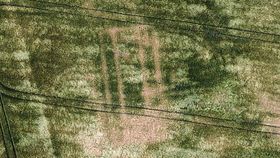
In a trial dig by Oxford University, archaeologists are using high-tech methods like magnetometry, which serves as an X-ray through the soil, to map out the floorplan of this ancient villa. They’ve found several walls, room outlines, and ditches – all without having set a shovel to soil. Westcott speculates the building was probably once a barn, but it could have also played an important role in everyday life beyond its residential use.
“The villa would be the real center of rural industry and agriculture and although the persons living there would have been very wealthy and powerful there would have been all sorts of things going on from the cooks to slaves – but grain was vitally important to them,” Westcott told the Banbury Guardian.
The scans also showed indications of a bath-house, a domed-roof, mosaics, a grand dining room, kitchen, and living room. Earlier excavations have turned up coins, trophies, boar tusks, pendants, and tiles indicative of early Roman home heating systems. Photos of the excavation show the nearly 180 items found cleaned and cataloged during the dig.
But who is the woman? Researchers aren’t sure. Ancient Romans inhabited Britain for nearly 400 years until the empire began collapsing during the third century. Given the amount of wealth surrounding her lead-lined tomb, it’s likely she was nobility. An analysis suggests she was just over 5 feet tall and in her 30s at the time of her death.
Westcott is approaching universities to secure funding for future excavations, which he suspects will cost around £2 million.


 [H/T: Banbury Guardian]
