


 PUBLISHED
 2
2


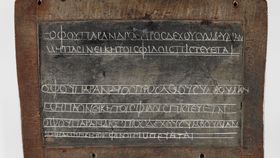


A wonderful slice of Ancient Egyptian life is about to go on display in the UK, after being in storage for over four decades, offering us a glimpse into life as a kid learning his letters nearly 2,000 years ago.
Turns out it wasn’t all divebombing the Nile and pranking your cat by mummifying it back then, children had schooling and homework too – or at least you did if you were male and highly born.
A wax tablet mounted in a wooden frame dating back to second-century-CE Egpyt, at that time under Roman Empire control, reveals the ancient lessons taught to elementary-school-age children 1,800 years ago. Though there is no name on the tablet, so the identity of the pupil is unknown, back then formal education was almost exclusively the realm of males from wealthy families.
The tablet reveals a lesson in ancient Greek, including a reading and writing exercise and multiplication table. Lines written presumably by a teacher have been copied out by a rather endearingly wobbly hand, though according to Peter Toth, curator of the exhibition to feature the tablet at London’s British Library, the sentences weren’t just for practicing the alphabet but also to impart moral lessons.
"It's not only the hands and fingers but also the mind that is being instructed here," Toth told Live Science.
The lessons to be learned included "You should accept advice from a wise man only" and "You cannot trust all your friends." Wise words indeed.
The wax, darkened like a precursor of blackboards to show off marks better, would have been melted and poured into a wooden frame and left to dry flat, allowing someone with a sharp tool to scratch into it.
It is thought these types of tablets were used with a stylus (like a precursor of BlackBerrys, really the ancient Egyptians were ahead of their time), one end sharpened to make the mark, the other flat that when heated up could remove mistakes by melting the wax.
That the tablet – about the size of a paperback book, or, again prophetically, your electronic tablet of choice – survived nearly 2,000 years is impressive. Wax typically breaks down in moisture so the dry clime of ancient Egypt would have helped preserve it.
The tablet, which was acquired by the British Library in 1892, hasn't been on display since the 1970s. It will now star in the upcoming exhibition Writing: Making Your Mark, exploring 5,000 years of writing from ancient civilizations to modern day at the British Library, London, from April 2019 onwards.
