


 PUBLISHED


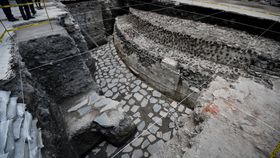


Buried beneath the streets of Mexico City for some 500 years, archaeologists have uncovered the stunning remains of an ancient Aztec temple, a ball court, and a potential sacrificial area. The remains are thought to date to the Spanish conquest, and help the team build a more detailed picture of the metropolis of Tenochtitlan before it fell to the conquistadors.
Despite its ruinous end, the temple is preserved in stunning detail, with white stucco still visible on some of the walls. The building was dedicated to the god of the wind, Ehecatl, and may have been topped with a structure that resembled a giant, curled serpent, which the priests entered via a doorway made to look like its nose. Located in the center of the ancient city, it was placed in the most sacred ceremonial region of the Aztec empire.
Excitingly, they have also uncovered the partial remains of a ball court alongside the temple. The Mesoamerican ball game involved participants using only their hips to hit a rubber ball around the court. These games often involved human sacrifice, with archaeologists finding 32 severed male vertebrae nearby.
“It was an offering associated with the ball game, just off the stairway,” archaeologist Raul Barrera told Reuters. “The vertebrae, or necks, surely came from victims who were sacrificed or decapitated.”
The structures are thought to have been built during the reign of Aztec emperor Ahuizotl, who ruled between the years 1486 and 1502, and just before Moctezuma came to power, who was eventually toppled by the Spanish.
Incredibly, the archaeologists think that the ball court may have been where the infamous conquistador Hernán Cortés watched a Mesoamerican ball game when he was welcomed into the city by Moctezuma, as described in the chronicles recounting the Spanish invasion and destruction of the Central and South American Aztec and Inca civilizations.
At the time of Cortés’ arrival in 1519, Tenochtitlan is thought to have been not only the largest city in the Americas, but one of the largest in the world. With a population estimated between 200,000 and 300,000, it would even have eclipsed London under Henry VIII during the same period. An astonishing feat of engineering, the city was built on an island and connected to the mainland by immense causeways running in all directions.
There are now plans to build a museum on the site and open it up to the public, although the date of this is still unknown.
