


 PUBLISHED


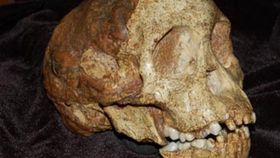


A CT scan of one of the most important early human fossils has cast doubt on claims that it shows early signs of some of our more distinctive features.
In 1924 the skull of an Australopithecus africanus child was found in Taung, South Africa, and named The Taung Child, the first fossil of an early hominid from Africa to be scientifically described. The skull became the subject of debate as to whether the child had died as a result of violence from its own species, or was killed by predators. This question has influenced changing perceptions as to how violent our ancestors were.
Despite the discovery of many more hominid fossils over almost a century, the Taung Child is still regarded as our best clue to the early stages of our brain’s evolutionary break from the other great apes. Claims have been made for signs of connective tissue dividing the frontal halves of the skull and a soft spot between the bones of the upper skull. These features are found in infant humans but not other primates at this age and are thought to be required for our brains to reach the size they do.
However, in Proceedings of the National Academy of Sciences a team led by Dr Kristian J. Carlson of the University of Witwatersrand performed high-resolution computed tomography on the Taung Child skull for the first time. "A recent study has described the roughly 3 million-year-old fossil, thought to have belonged to a 3 to 4-year-old, as having a persistent metopic suture and open anterior fontanelle, two features that facilitate post-natal brain growth in human infants when their disappearance is delayed,” Carlson says.
Crucially, previous research has claimed to find evidence of early prefrontal lobe expansion, making room for the parts of the brain responsible for functions such as verbal abilities and our capacity to fit into social norms. Since this is the only fossil prior to the appearance of the Homo genus for which these claims have been made, settling the question has important implications for ideas of when our large brains really got going.
The scans “do not support the metopic and fontanelle features proposed,” the paper concludes, and the authors question whether these wold be needed for prefrontal lobe growth.
