Technology
 PUBLISHED


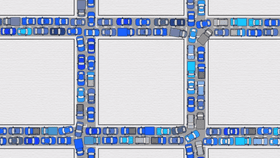


When you're driving down the highway and you suddenly hit a jam, it often seems a mystery how and where this traffic begun, provided there’s not a nasty pile-up waiting at the end of it. The ever-awesome CGP Grey has created this simple explanation of how traffic forms, what we can do (as mere humans) to help ease them, and ultimately how self-driving cars could end all our traffic jam woes.
It’s all to do with coordination – something that a hoard of distracted, radio-changing humans aren’t particularly good at.
If every driver on a simple straight road, like a highway, was able to coordinate their rate of acceleration and timing with the car in front and behind, then there wouldn’t be a problem. All it takes is one driver to decelerate a bit. Natural human reaction time means they are not completely in sync with this action in front, so they have to break a little harder than the car in front, and so on and so on.
Eventually, this causes what's known as an “accordion effect". Hypothetically, even if there was an unending circular road, just one car hesitating or slowing down could easily cause a hellish infinite loop of traffic.
On the other hand, autonomous cars are capable of instantaneous communication, processing the information and coordinating themselves into one massive feedback system. That’s the idea at least. See what you think.